The Story Behind the Song
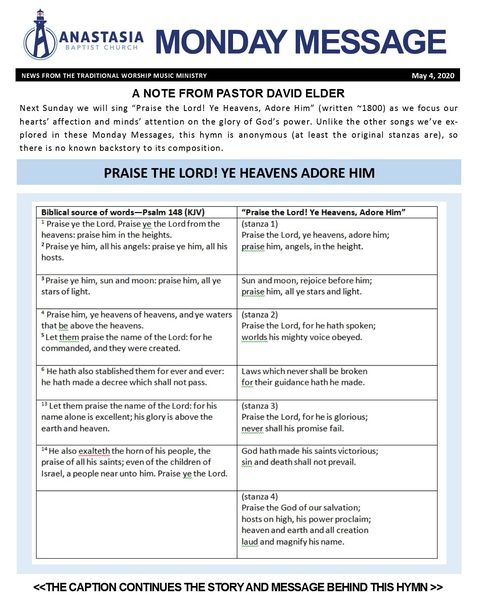

Next Sunday we will sing “Praise the Lord! Ye Heavens, Adore Him” (written ~1800) as we focus our hearts’ affection and minds’ attention on the glory of God’s power. Unlike the other songs we’ve explored in these Monday Messages, this hymn is anonymous (at least the original stanzas are), so there is no known backstory to its composition.
//
“Praise the Lord!” began as a paraphrase of Psalm 148 in four stanzas. (In the version we sing today, the initial stanzas one and two are combined into a single first stanza, and the original third and fourth are combined into a single second stanza. The third was appended later.) A psalm paraphrase is a rewording of the intent or meaning of the original psalm into poetic lines that can be more easily sung. The chart below shows the prose of Psalm 148 from the King James Version, the most popular English Bible at the time of the hymn’s publication in the 1700s, and the poetic paraphrase we sing today. Stanzas 1, 2 and 3 are paraphrases of Psalm 148:1-3, 4-6, and 13-14, respectively. The fourth stanza is a summation of the song.
//
In stanza 1, we’re commanded, along with the angels and created heavenly bodies, to praise God. Our English word “praise,” which means to express a favorable judgment of something or to commend it, is derived from the same root as our English word “appraise,” which means to set a value on something or assign it a price. When we rightly praise God, we express to Him that we acknowledge His goodness, power, love, etc. and that He is of ultimate worth, that He holds the highest value, in our lives.
//
The second stanza repeats the directive to praise God, but it now gives a reason to do so—“for he hath spoken.” This refers back to the Genesis account of creation, when God spoke the world and all it contains into being. We praise God for what He’s done in creating us and what He’s continuing to do in guiding us. But it also brings to mind the opening words of the book of Hebrews: “Long ago, at many times and in many ways, God spoke to our fathers by the prophets, but in these last days he has spoken to us by his Son, whom he appointed the heir of all things, through whom also he created the world” (Hebrews 1:1-2). Jesus is certainly a reason to praise God!
//
Likewise, the third stanza echoes the edict to praise, but the reason given is not for what God has done, but rather for who He is—“for he is glorious.” God’s worthiness to receive praise is not based solely on what He does, but also on who He is. There is inherent value in God’s being, in his essence. Again, the writer of Hebrews adds: “He [Jesus] is the radiance of the glory of God and the exact imprint of his nature, and he upholds the universe by the word of his power. After making purification for sins, he sat down at the right hand of the Majesty on high, having become as much superior to angels as the name he has inherited is more excellent than theirs” (Hebrews 1:3-4).
//
The final stanza of the original hymn acts as a recap of the psalm and gives the Old Testament song a decidedly New Testament flavor. The first three original stanzas referenced God’s act of creation and his ongoing care for His people through guiding and providing. They are written from the perspective of one who speaks to created heavenly beings and bodies—heavens, angels, sun, moon and stars. But the last stanza tells of God’s act of re-creating us through the salvation that is made possible by Jesus’ death and resurrection—“Therefore, if anyone is in Christ, he is a new creation. The old has passed away; behold, the new has come” (2 Corinthians 5:17). In this original fourth stanza, the earthbound singer joins with the celestial figures to join in the praise.
//
In 1836, an additional stanza was added to the hymn. Initially written as a stand-alone, single-stanza hymn, “Worship, Honor, Glory, Blessing” was added to “Praise the Lord!” as a third stanza. It is an amazing parallel to the original Psalm 148. Worship is expressed to God (see Psalm 148:1); it’s offered by people of all ages (148:7, 12); specific mention is made of the saints of the Lord (148:14); and there is an allusion to the Lord’s Prayer (Matthew 6:10).
//
As was the case with the original fourth stanza, this added stanza is written in first person, so the singer is part of the action—he or she is offering the praise, bending the knee and bowing before the throne.//The author of the last stanza makes an important point. Worship that is authentic and God-honoring begins with praise—“worship, honor, glory, blessing”—but it doesn’t end there. The true worshipers that the Father is seeking (John 4:23) go on to sacrificial serving and can honestly pray the Lord’s Prayer (“So on earth Thy will be done”) because they, like the angels in heaven and Jesus in the Garden of Gethsemane, have submitted themselves to the Father’s will.
//
As we sing on Sunday, we’ll be joining our voices not just with the people in the place we are, whether that place is our living room or the church’s sanctuary, but also with believers around the globe. And not just with those living on earth now, but also with those saints who have preceded us to heaven. And not just with the redeemed of humanity, but also the cherubim and seraphim. What a privilege to participate as “heaven and earth and all creation laud and magnify his name”!
///
 Anastasia Music