The Story Behind the Song
You can watch the song here.
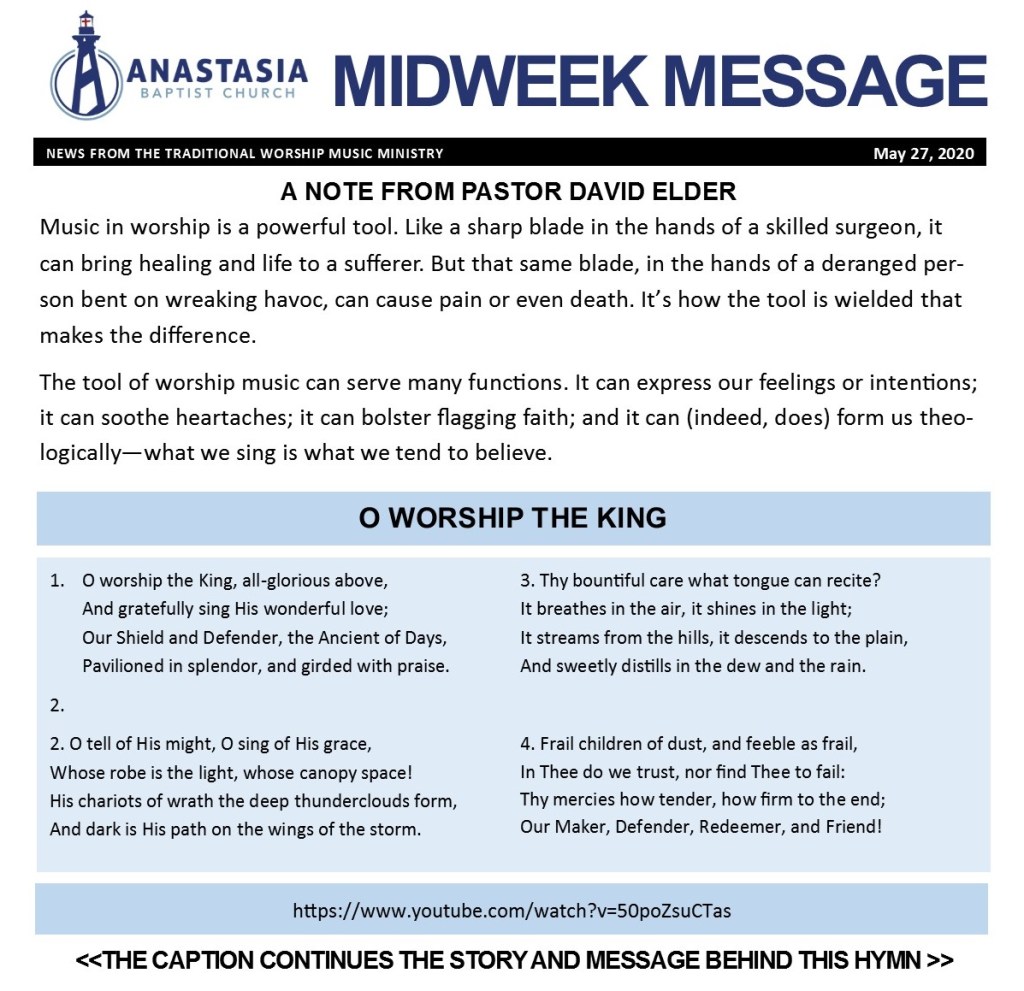
In both the Old and New Testaments, God’s Word speaks to the power of music to teach us who God is and what he does and, in contrast, who we are, and how we should relate to God. When God told Moses that he was soon to die and to install Joshua as the new leader of the Israelite nation, he gave Moses one last task to fulfill: “Now therefore write this song and teach it to the people of Israel. Put it in their mouths, that this song may be a witness for me against the people of Israel” (Deuteronomy 31:19). Moses’ swan song (Deuteronomy 32:1-43) reminded the people of God’s character and how he had dealt with them faithfully. But it also told of how the people had spurned their Lord and suffered, and how God would restore his people if they turned back to him.
//
In the New Testament, Paul wrote: “Let the word of Christ dwell in you richly, teaching and admonishing one another in all wisdom, singing psalms and hymns and spiritual songs, with thankfulness in your hearts to God” (Colossians 3:16). He spoke of the educational, formative power of psalms, hymns and spiritual songs.
//
In “O Worship the King,” author Robert Grant (1779-1838) uses seven phrases (in the four stanzas found in our current Baptist hymnal) to describe who God is. In the opening one, we’re enjoined to “worship the King.” A king is one who holds authority and reigns over a city, nation or people. Psalm 10:16 says, “The Lord is king forever and ever.” The hymn teaches us that God holds the right to rule our lives. When Jesus gave his final words of commission before returning to heaven, he told his disciples that “All authority in heaven and on earth has been given to me” (Matthew 28:18); it’s no wonder, then, that Jesus is King of kings and Lord of lords (Revelation 19:16).
//
The hymn also refers to God as our Shield and Defender. When the Lord told the aged Abram that his heir would be a child of his own body, he assured the patriarch with a promise of protection: “Fear not, Abram, I am your shield” (Genesis 15:1). That protection extends to all God’s people, not just physical descendants of Abraham. The prophet Isaiah foretold of a time when the Lord would be worshiped even in Egypt: “When they [i.e., Egyptian believers] cry to the Lord because of oppressors, he will send them a savior and defender, and deliver them” (Isaiah 19:20).
//
The first verse of “O Worship the King” also denotes God as the Ancient of Days. This is a direct quote from the prophecy of Daniel. Three time in chapter 7 (verses 9, 13 and 22), the prophet describes God as the Ancient of Days, referring to his eternality—without beginning or end.
//
In the last of the four stanzas we sing, Grant reminds us of how we stack up to God. Humans are labeled “frail children of dust” (alluding to Genesis 2:7—“the Lord God formed the man of dust from the ground”) who are as feeble as we are frail. But our weakness stands in stark contrast to God’s power. The last line of the fourth stanza ends with a four-fold descriptor of our God that recaps the gospel—Maker, Defender, Redeemer and Friend.
//
God is our Maker—as Creator, God, “for his own glory, [brought] into existence everything in the universe, things that had no existence prior to his creative word.”[1]Our Maker also takes people who were dead in their trespasses and sins (Ephesians 2:1-5) and makes them into new creations (2 Corinthians 5:17).
//
God is our Defender—but just because we’re saved doesn’t mean Satan gives up the hunt (1 Peter 5:8). Once we’ve accepted the offer of salvation, God keeps safe his own: “The God of peace will soon crush Satan under your feet” (Romans 16:20).
//
God is our Redeemer—as believers we are both presently redeemed (Romans 3:23-24) and we will, in the future, be redeemed (“I shall ransom them from the power of Sheol; I shall redeem them from Death” (Hosea 13:14).) So we wait for that promised Day of Redemption (Ephesian 4:30).
//
God is our Friend—Jesus said that his followers are more than mere robotic servants who blindly obey orders from the Master with no insight as to the why; “but I have called you friends, for all that I have heard from my Father I have made known to you” (John 15:15).
//
If this hymn were the only source of knowledge we had as to who God is and what he’s doing, who we are, and how we relate to him, we could learn that God is potent and majestic in stanzas one and two. The third would show us that he cares for us. The last reveals that we are powerless to help ourselves but that, if we place our trust in God, he is completely capable of saving. Such a God—powerful, mighty, glorious as well as loving and compassionate—is worthy of worship!
///
 Anastasia Music