The Story Behind the Song
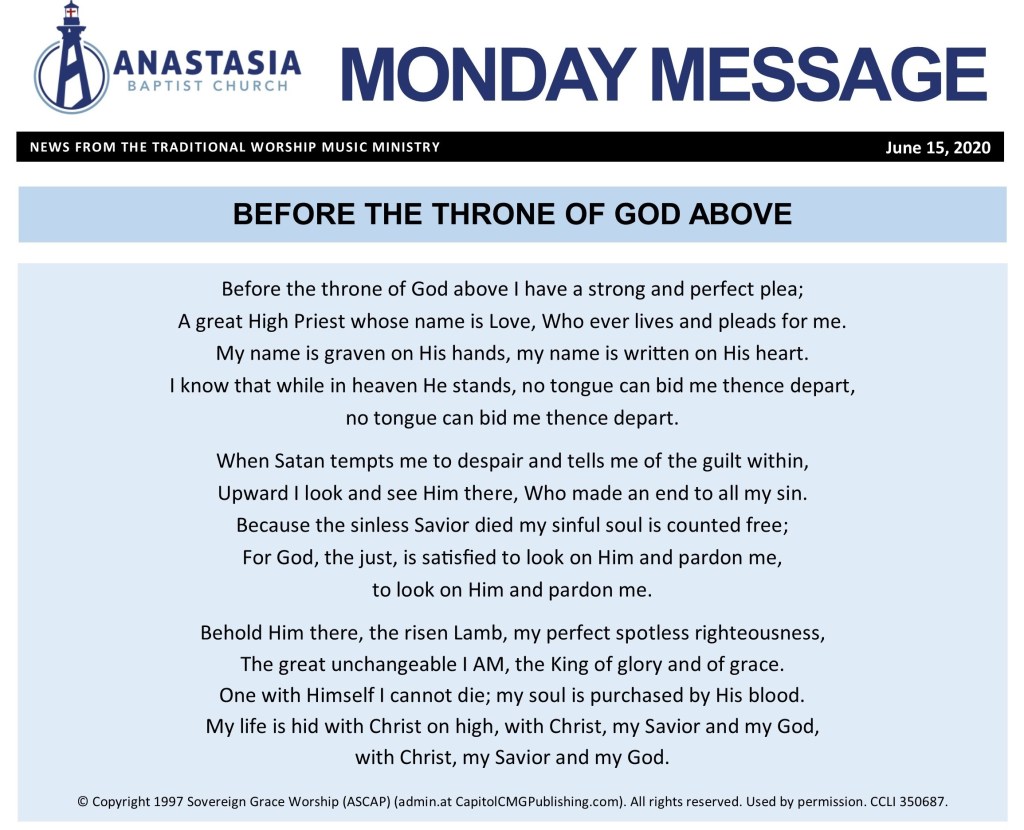
It’s not unusual for a song to be written and recorded, enjoy a brief period of popularity, then fade into obscurity. It happens all the time in both the secular and Christian music arenas. Then there are songs that have cyclical comebacks. “The Lion Sleeps Tonight,” for example, has been recorded multiple times in every decade since the 1960s. There are some songs, however, that were written in past centuries and are still sung to this day—Christian songs like “Amazing Grace,” “Christ the Lord Is Risen Today” and many, many Christmas carols, and nonspiritual pieces like “The Star-Spangled Banner” and even “Happy Birthday.”
But there is only one that was written in the mid-1800s, had a season of acceptance and usage, drifted into the background, then was fitted with a new tune and introduced to a new generation of believers and is now #93 on the CCLI Top 100 songs (as of Monday, June 15, 2020) and is currently found in 44 hymnals.
The words of “Before the Throne of God Above” were written by an Irish woman, Charitie Lees Bancroft (1841–1923), and were first published in “The Praise of Jesus” (1863) in England. The hymn was originally sung to common tunes of the day, such as the tune to which we sing “Sweet Hour of Prayer.” It was republished in an early American Baptist hymnal, “The Baptist Hymn and Tune Book, for Public Worship” (1871) and again in England in Charles Spurgeon’s “Our Own Hymn Book” in 1884.
The text was rediscovered in the 1970s, but it wasn’t until a new tune was composed that “Before the Throne of God Above” became widely known again. Interestingly, it was another woman, Vikki Cook, who wrote the tune we sing today and which contributed greatly to the hymn’s resurgence. She writes:
“I first heard ‘Before the throne of God above’ on a Sunday morning at church in 1997. One of our pastors had just come back from a conference in England and brought the song back with him. All of us on the worship team learned and rehearsed the song before church, then taught it to the congregation later that morning. The song bombed! The church didn’t respond to the song favorably. I think the old melody was a little too strange sounding to our American ears. The music was the melody called JERUSALEM [by Hubert Parry], but it was not a very good match for these words and did nothing to highlight the truths being communicated. I didn’t care for the melody much either, but I fell in love with the words!
“The original words really impacted me. I couldn’t believe that I’d never heard of this hymn before! I took home a copy of the words and stuck them in my Bible. During my quiet times, I would take out the lyrics and be so affected by them, especially verse two, ‘When Satan tempts me to despair, and tells me of the guilt within, upward I look and see HIM there, who made an end of all my sin.’ I spent many mornings with God weeping over those lyrics. I had to find a way to sing these words to God, even if it was only for myself. When I made up my mind to write a new melody it came surprisingly quick, in about an hour. (This is not the ‘norm’ for our songwriting—my husband, Steve, and me—we spend weeks, if not months, writing and re-writing.) I played it for my husband, Steve, and he liked it, so we recorded it. We played it for our worship leader, and the song just kind of ‘snowballed’ from that time since. I’m amazed at how God has used this song in the church at large, especially when I think that I just wrote this new melody so that I could worship God in my quiet times with Him. Even though it has been several years, I still weep when I sing the part that says, ‘for God the Just is satisfied to look on Him, and pardon me.’”
There’s an old saying, “Whenever Satan reminds you of your past, just remind him of his future” (spoiler alert: see Revelation 20:10—it doesn’t end well for the devil). “Before the Throne of God Above” is a song of great assurance. It declares the certainty of God’s love and provision in the here and now, and the security of His beloved forevermore. So if virus or violence leads you to despair, look up and see Jesus, “a great High Priest whose name is Love,” and know that, if you’ve accepted His offer of salvation, “[your] name is graven on His hands, [your] name is written on His heart,” “[your] sinful soul is counted free,” “[your] soul is purchased by His blood,” and “ [your] life is hid with Christ on high.”
 Anastasia Music