The Story Behind the Song
You can watch the video online at https://www.youtube.com/watch?v=dTKIqmdfHSk
Throughout the Bible, men and women expressed their own sense of inadequacy to be used by God. Abraham, while pleading for leniency for any righteous people in Sodom or Gomorrah, said, “I have undertaken to speak to the Lord, I who am but dust and ashes” (Genesis 18:27). Moses, when commissioned by God to lead His people out of slavery, said, “Who am I that I should go to Pharaoh and bring the children of Israel out of Egypt?” (Exodus 3:11). David, when God announced His covenant with the king’s dynasty, said, “Who am I, O Lord God, and what is my house, that you have brought me thus far?” (2 Samuel 7:18). David’s son Solomon, when preparing to build God’s temple, said “Who am I to build a house for him?” (2 Chronicles 2:6). Esther, when faced with the destruction of her Jewish kinsmen, took her life in her own hands by appearing before the king without being summoned and said, “If I perish, I perish” (Esther 4:16). An anonymous psalm writer said, “My soul is full of troubles, and my life draws near to Sheol. I am counted among those who go down to the pit; I am a man who has no strength” (Psalm 88:3-4). Isaiah said, “Woe is me! For I am lost; for I am a man of unclean lips” (Isaiah 6:5). Jeremiah said, “I do not know how to speak, for I am only a youth” (Jeremiah 1:6), a sentiment shared by Timothy (1 Timothy 4:12). John the Baptist said of Jesus, “He who is mightier than I is coming, the strap of whose sandals I am not worthy to untie” (Luke 3:16). Paul said that he was a “wretched man” (Romans 7:24) who was the foremost of sinners (1 Timothy 1:15).
//
Yet, in spite of their self-doubts, God used all those people in mighty ways, not because of who they were, but because of Who He is. The God Who spoke the universe into existence and told Paul, “My power is made perfect in weakness” (2 Corinthians 12:9) is the same One who says to us today, “I will never leave you nor forsake you” (Hebrews 13:5).
//
If there ever was a man who might say to God, “Who am I that you could use me?” it was Thomas O. Chisholm (1866-1960). He was a man who was extraordinarily ordinary. He did not come from a renowned family—he was born in a log cabin in Kentucky in 1866. He did not have astonishing talents; he described himself as “just an old shoe.” He did not accumulate abundant wealth. As an elderly man, he wrote, “My income has not been large at any time due to impaired health in the earlier years which has followed me on until now.” He did not achieve greatness in business, working at various times as a school teacher, newspaper editor, pastor, and insurance salesman.
//
His was not an amazing journey of faith. He did not meet God in a burning bush as Moses had, or see him high and lifted up as had Isaiah. He was not knocked off his horse on the road to Damascus like Paul. In fact, Chisholm did not come to know Jesus until he was 27 years old. Over ten years later he was ordained a pastor, but his poor health forced him to resign that position a year later, so the majority of his adult life was spent as a life insurance agent in New Jersey. All things considered, Thomas Chisholm was simply a “faithful man with a simple faith in a faithful God.”
//
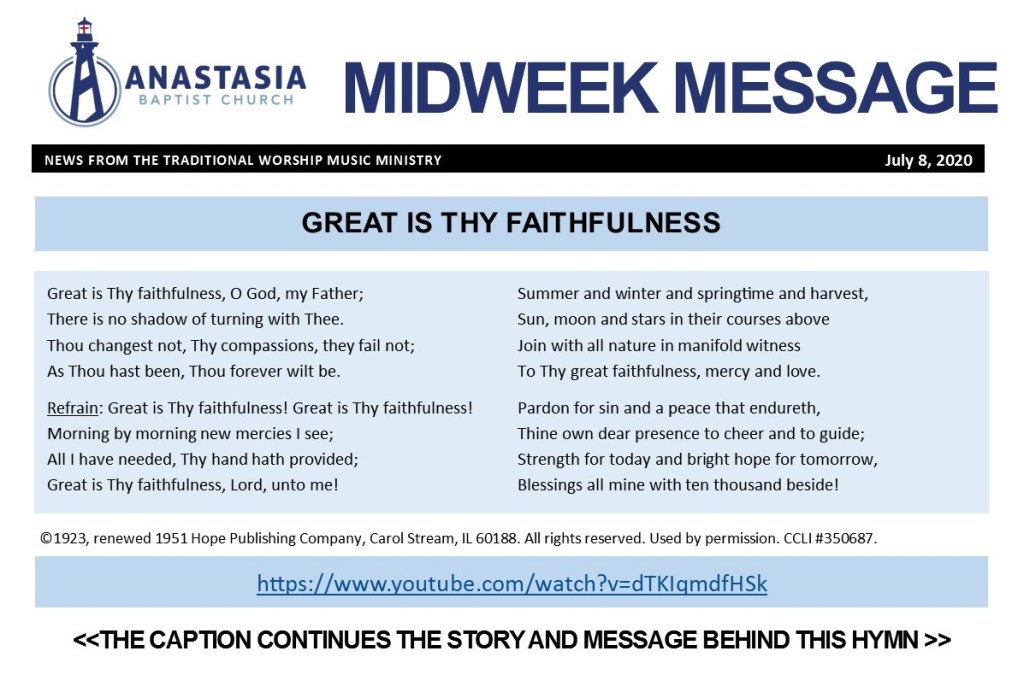
But one thing he could do was write poetry, penning 1,200 works throughout his life, with 800 of them seeing publication in religious papers like “Sunday School Times”, “Moody Monthly” and “Alliance Weekly.” “Great Is Thy Faithfulness” was one such poem, written in 1923 and set to music by his friend William H. Runyon, a musician at Moody Bible Institute in Chicago. Runyon later wrote: “This particular poem held such an appeal that I prayed most earnestly that my tune might carry over its message in a worthy way, and the subsequent history of its use indicates that God answered prayer.”
//
The hymn is an explication of God’s faithfulness. Its refrain is based on Lamentations 3:22-23 (KJV): “It is of the Lord’s mercies that we are not consumed, because his compassions fail not. They are new every morning: great is thy faithfulness.”
//
The first stanza speaks of the faithfulness of God’s character. In His perfection, God does not change—to do so would mean that He has either improved from a previous, lesser state; or that He has degenerated in some way from a previous, greater state to a reduced being. The stanza alludes to James 1:17 (KJV)— “Every good gift and every perfect gift is from above, and cometh down from the Father of lights, with whom is no variableness, neither shadow of turning.”
//
The second stanza refers to how God’s creation testifies to His “faithfulness, mercy and love.” The unfailing rhythm of the seasons and the consistent and reliable movements of the heavenly bodies—all of creation—point to a Creator Who Himself is unfailing, consistent and reliable. As the psalmist David wrote, “The heavens declare the glory of God, and the sky above proclaims his handiwork” (Psalm 19:1, ESV).
//
The last stanza declares the faithfulness of God’s care and provision throughout life. Pardon for sin that leads to salvation and begins the process of justification, the peace and strength from having the presence of Emmanuel—“God with us”— in our lives, the hope of heaven for everlasting tomorrows—“Blessings all mine with ten thousand beside!”
//
Great, indeed, is the faithfulness of God!
 Anastasia Music