The Story Behind the Song
The song can be viewed at https://www.youtube.com/watch?v=YOaP3hM02mA
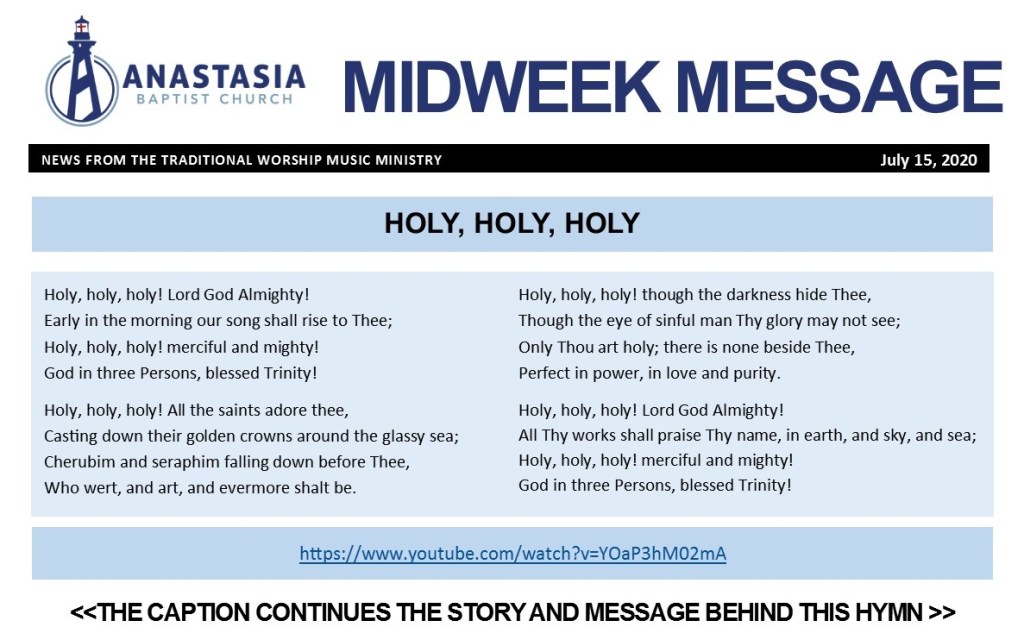
“Holy, holy, holy.” Just one word stated three times. It’s a simple phrase, but it has such rich meaning. It’s found in both the Testaments. In the Old, the prophet Isaiah received a vision of heavenly worship eight centuries before the birth of Christ: “In the year that King Uzziah died I saw the Lord sitting upon a throne, high and lifted up; and the train of his robe filled the temple. Above him stood the seraphim. Each had six wings: with two he covered his face, and with two he covered his feet, and with two he flew. And one called to another and said: ‘Holy, holy, holy is the Lord of hosts; the whole earth is full of his glory!’” (Isaiah 6:1-3).
//
Nine hundred years later, the Apostle John was given a glimpse into heaven which had striking similarities to Isaiah’s. John also saw God seated on a throne in heaven (Revelation 4:2-3). He was surrounded by angelic beings with six wings (Revelation 4:6-8a). And they sang the same basic song: “Holy, holy, holy, is the Lord God Almighty, who was and is and is to come!” (Revelation 4:8b).
//
Fast forward another seventeen centuries and we find Reginald Heber (1783-1826), an Anglican rector in the country parish of Hodnet in the west of England. His denomination, the Church of England, at that time sanctioned only the singing of versified psalms in worship, but Heber knew the power of hymn singing among the dissenting groups of Methodists and Baptists and wrote several hymns. At some time during his ministry at Hodnet (1807-1823), he penned the words to “Holy, Holy, Holy,” a hymn intended to be sung on Trinity Sunday, the day in the Christian calendar that celebrates the doctrine of one God Who reveals Himself as Father, Son and Holy Spirit. He petitioned church authorities to admit hymn singing into the liturgy, but was denied.
//
In 1823, at forty years of age, Heber was appointed the Bishop of Calcutta and went to India. There he immersed himself in his work as a missionary: “No memory of Indian annals is holier than that of the three years of ceaseless travel, splendid administration, and saintly enthusiasm, of his tenure of the see of Calcutta. He ordained the first Christian native—Christian David. His first visitation ranged through Bengal, Bombay, and Ceylon; and at Delhi and Lucknow he was prostrated with fever. His second visitation took him through the scenes of Schwartz’s labours in Madras Presidency to Trichinopoly.” But in 1826, just days before his forty-third birthday, Heber’s life was cut short by a stroke.
//
After his death, his widow published his 57 hymn texts in “Hymns Written and Adapted to the Weekly Church Services of the Year” (1827). From that initial collection, “Holy, Holy, Holy” has gone on to be published in more than 1,400 hymnals and sung by Christians of multiple (and no) denominations in portions of three different centuries. In an article entitled “Top 10 Most Popular Hymns of All Time and Their History” written in 2013 and updated in 2016, it was the second hymn listed, surpassed in popularity only by John Newton’s “Amazing Grace.” And in the March 2011 edition of “Christianity Today,” in “The Hymns That Keep on Going,” the findings of a study were reported. The project had surveyed the 28 hymnals published by mainline Protestant denominations (Anglican/Episcopal, Baptist, Congregational, Lutheran, Methodist and Presbyterian) from the late 1800s to the time of the research. Of the 4,905 hymns in those 28 books, thirteen songs were found in every one of the hymnals. “Holy, Holy, Holy” was, of course, one of the thirteen that has proven to be a staple of Protestant hymnody.
//
From Isaiah’s vision, to John’s revelation, to Heber’s inspiration, people who see God for Who He truly is all come to the same conclusion: that God is holy, and that we are not. Isaiah cried out, “Woe is me! For I am lost; for I am a man of unclean lips, and I dwell in the midst of a people of unclean lips; for my eyes have seen the King, the Lord of hosts!” (Isaiah 6:5). John, when he saw the glorified Jesus, “fell at his feet as though dead” (Revelation 1:17). And Heber encourages us to emulate the saints who are “casting down their golden crowns around the glassy sea.” Confession and repentance like the prophet, abject humility like the apostle, complete and total surrender like the hymn writer—all are appropriate responses to a God Who is holy, holy, holy.
 Anastasia Music