The Story Behind the Song
The first version of this song can be viewed at https://www.youtube.com/watch?v=KOWqMwqzUjM and the 2005 version can be viewed at https://www.youtube.com/watch?v=BRVNZPyMOcM
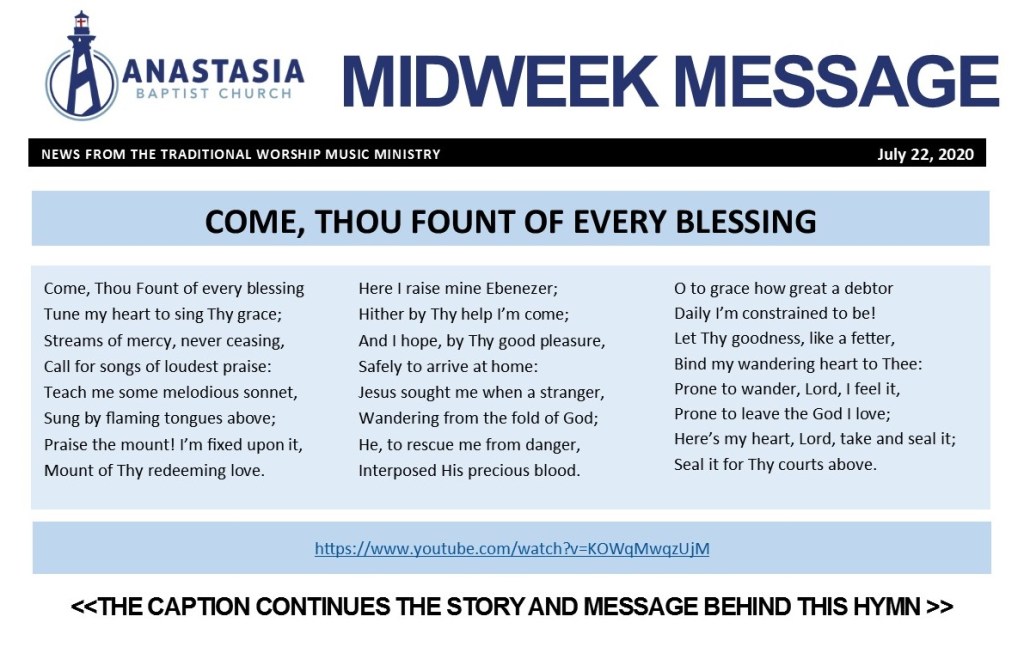
Robert Robinson (1735-1790), an English Baptist minister, wrote “Come, Thou Fount of Every Blessing” in 1758 on the three-year anniversary of his conversion. Six years prior, the 17-year old boy had heard the renowned Methodist revivalist George Whitefield preach a sermon from the text, “Who hath warned you to flee from the wrath to come?” (Whitefield came to the colonies seven times between the 1730s and 1760s and preached throughout America. In his autobiography, Benjamin Franklin, who became a personal friend of Whitefield’s, once attended a Whitefield meeting “to observe the extraordinary Influence of his Oratory on his Hearers” and concluded that “it was wonderful to see the Change soon made in the Manners [behavior] of our Inhabitants; from being thoughtless or indifferent about Religion, it seem’d as if all the World were growing Religious; so that one could not walk thro’ the Town in an Evening without Hearing Psalms sung in different Families of every Street.”)
//
Young Robert, like Franklin, had gone to hear Whitefield out of curiosity, intending to heckle the preacher, but came away convicted and spent the next two and a half years wrestling with the call of Christ on his life. Finally, near the end of 1755, Robert Robinson found “full and free forgiveness through the precious blood of Jesus Christ” and became a Methodist lay preacher.
//
After further study of the Bible, during which time he wrote the hymn, Robinson became convinced that baptism was only for those who had professed faith in Christ (that is, not for infants) and was to be administered by immersion (not pouring or sprinkling) and became a Baptist. He was ordained and called to pastor the Stone Yard Baptist Church in Cambridge, a position he held for almost thirty years (1761-1790) until his death.
//
In “Come, Thou Fount of Every Blessing,” written by a 23-year old young man who had been a Christian for only three years, a wealth of Biblical allusions is found. In the first stanza, the fount or source from which unceasing streams of mercy flow evokes Jesus’ words to the woman at the well: “Everyone who drinks of this water (i.e., the physical water from Jacob’s well) will be thirsty again, but whoever drinks of the water that I will give him (i.e., salvation) will never be thirsty again. The water that I will give him will become in him a spring of water welling up to eternal life” (John 4:13-14).
//
The second stanza begins with “Here I raise mine Ebenezer.” During the time of the Judges, when the people of Israel had been threatened by the Philistines, God had miraculously saved them. Samuel had then erected a memorial to commemorate God’s rescue and named it Ebenezer, which means “stone of help,” “for he said, ‘Till now the Lord has helped us’” (1 Samuel 7:12). As he remembered his own rescue from sin three years earlier, Robert Robinson built his memorial not of stone but of poetry.
//
The stanza continues, “Jesus sought me when a stranger, Wandering from the fold of God.” That line references both the Old and New Testaments. In the Old, the prophet Isaiah wrote, “All we like sheep have gone astray; we have turned—every one—to his own way” (Isaiah 53:6). In the New, Jesus told a parable of lost sheep and the shepherd who pursued them: “What man of you, having a hundred sheep, if he has lost one of them, does not leave the ninety-nine in the open country, and go after the one that is lost, until he finds it?” (Luke 15:4). In chapter ten of John’s gospel, Jesus names himself as that good shepherd.
//
The last stanza commonly sung today (there was a fourth that has fallen out of use) ends with, “Here’s my heart, Lord, take and seal it; Seal it for Thy courts above.” This recalls Paul’s beautiful Trinitarian formulation that speaks to how God secures we who are “prone to wander…, prone to leave the God [we] love”—“It is God [the Father] who establishes us with you in Christ [the Son], and has anointed us, and who has also put his seal on us and given us his Spirit in our hearts as a guarantee” (2 Corinthians 1:21-22).
//
Robert Robinson has been dead for almost two and a half centuries, yet his song lives on. In 2005, Thomas Miller wrote a new second stanza and added a chorus to produce “Come Thou Fount, Come Thou King” (click here to hear that version) and a whole new generation of believers is having its heart tuned to sing of God’s grace. Let’s join our voices in songs of loudest praise!
 Anastasia Music