The Story Behind the Song
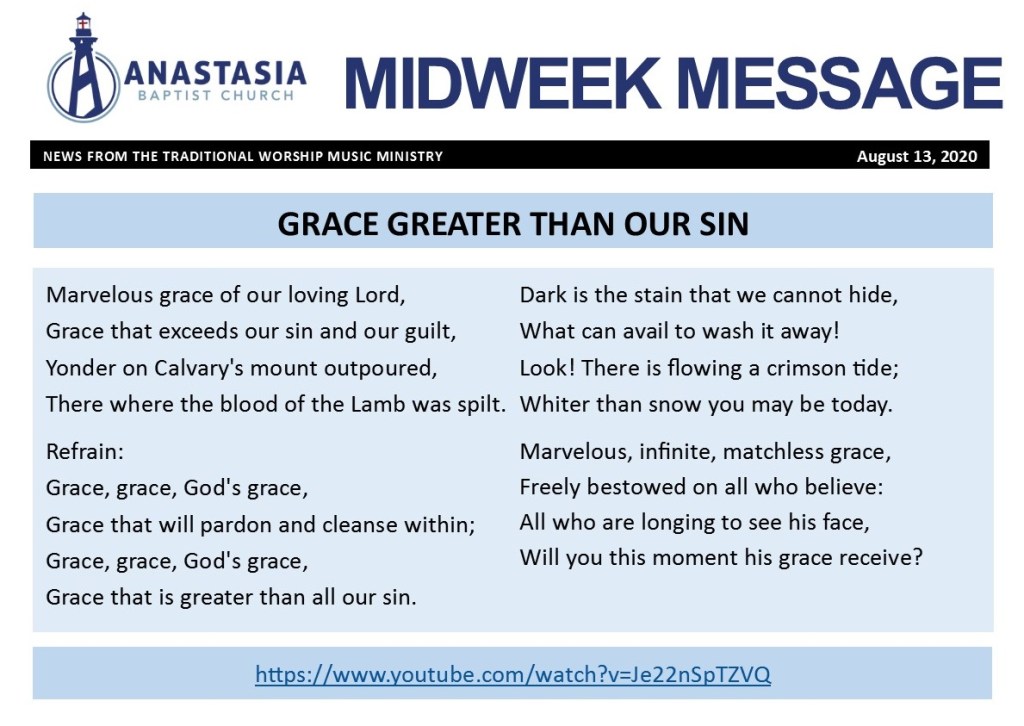
This song can be viewed on YouTube by clicking here.
//
There’s an old adage—“Will it play in Peoria?”—that has been in use since the mid- to late-1800s. It refers to whether a certain product or idea will be successful or resonate with the average, mainstream American. That’s because Peoria is “located in the heart of Illinois as well as the heart of the nation” and is considered to be a representative American small city—a sort of “Anytown, USA.” But the phrase is not merely metaphorical. “Peoria has a long history as a test market for products of all kinds,” including Orange Crush soda, Folger’s coffee and French’s mustard in the 1950s, Pampers diapers in the 1960s, and Pringles potato chips and Country Time lemonade in the 1970s.
//
One thing that played well in Peoria—and has continued to play well for over a century—is a hymn written by a woman who spent all but the first six of her seventy years of life there. Julia Harriette Johnston’s (1849-1919) father was a Presbyterian minister and her mother a poet. Their daughter showed evidence of both her father’s faith and her mother’s literary skills, writing hundreds of hymns and Christian songs, children’s Sunday School materials, and several books, including “The Life of Adoniram Judson: Missionary to Burmah, 1813 to 1850,” “The School of the Master: and Other Religious Verses,” “Indian and Spanish Neighbors,” and “Fifty Missionary Heroes Every Boy and Girl Should Know.”
//
But her best known and most influential work was the hymn “Grace Greater than Our Sin.” Written by 1911, the hymn has been published in at least 127 hymnals. Its lyrics, particularly in the refrain, speak of the abundance of God’s grace, and how it is more than sufficient to deal with our sin, echoing the theology of the apostle Paul: “…where sin increased, grace abounded all the more” (Romans 5:20).
//
The first stanza reminds us of the source of that unmerited favor—God’s great love—and how it was put on display for all to see: “God shows his love for us in that while we were still sinners, Christ died for us” (Romans 5:8).
//
The original second stanza has fallen into disuse:
Sin and despair, like the sea waves cold,
Threaten the soul with infinite loss;
Grace that is greater—yes, grace untold—
Points to the refuge, the mighty cross.
//
It could refer to Psalm 88:7, “Your wrath lies heavy upon me, and you overwhelm me with all your waves.” Yet in God’s grace, He provides a place of safety, a refuge, through the work of Jesus at Calvary—“For the word of the cross is folly to those who are perishing, but to us who are being saved it is the power of God” (1 Corinthians 1:18).
//
In stanza three, Johnston addresses our inability to deal with our sin on our own terms and in our own strength. “Dark is the stain that we cannot hide” because “Though you wash yourself with lye and use much soap, the stain of your guilt is still before me, declares the Lord God” (Jeremiah 2:22). But what we could not do at all, God accomplished to the utmost: “Purge me with hyssop, and I shall be clean; wash me, and I shall be whiter than snow” (Psalm 51:7).
//
The hymn ends with an invitation. After the author recapped the quality (“marvelous, infinite, matchless”) and availability (“freely bestowed”) of God’s grace, she asked the question each of us must deal with if we wish to stand in a right relationship with Jesus—“Will you this moment his grace receive?” Grace is indeed an offered gift, but to be effective, it must be received by faith, since “…all have sinned and fall short of the glory of God, and are justified by his grace as a gift, through the redemption that is in Christ Jesus, whom God put forward as a propitiation by his blood, to be received by faith” (Romans 3:23-25).
//
Grace, grace, God’s grace—it’s a gift that plays well not only in Peoria, but throughout all the world and for all of time.
//
 Anastasia Music