The Story Behind the Song
This song can be viewed on YouTube by clicking here.
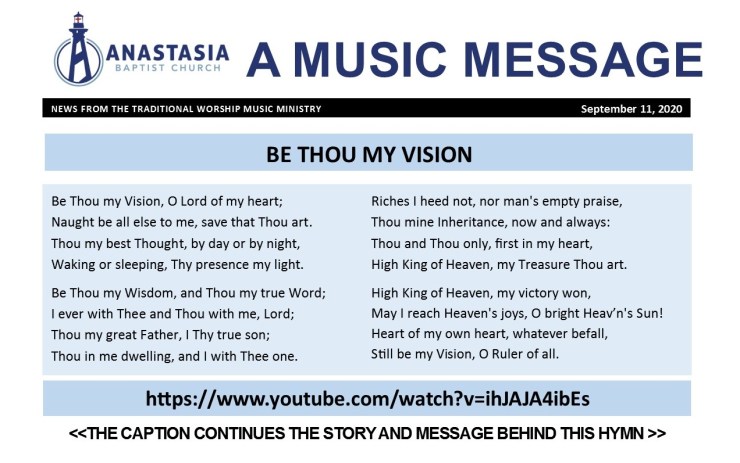
The word “vision” has several interrelated meanings. In its most basic sense, it means the ability to see, as in, “I’ve got 20/20 vision.” This is the connotation of the word as it’s used in Isaiah 28:7, where the prophet condemns the false religious leaders of the day who “are swallowed by wine, they stagger with strong drink, they reel in vision, they stumble in giving judgment.”
//
But the much, much more common usage of “vision” in the Bible refers to a unique way that God reveals Himself and speaks to humanity. Throughout the Old and New Testaments, God sends visions to the patriarchs, priests, prophets and apostles, special glimpses into His own character and messages of warning and edification. Many times, after an encounter with God through a vision, a person underwent a drastic transformation often underscored by a change of name: Abram to Abraham and Sarai to Sarah (Genesis 17), Paul to Saul (Acts 13).
//
The origin of the hymn “Be Thou My Vision” lies in a prayer by Saint Dallan or Dallán Forgaill, a sixth-century Celtic monk and poet who became blind during his lifetime. In 1905, Irish scholar Mary Byrne (1880-1931) translated the prayer from Old Irish into modern English, beginning with:
Be thou my vision, O Lord of my heart.
None other is aught but the King of the seven heavens.
//
Shortly thereafter, Eleanor Hull (1860-1935), founder of the Irish Text Society and president of the Irish Literary Society of London, converted Byrne’s prose into the poetic version we sing today, publishing her hymn in 1912.
//
The text of “Be Thou My Vision” is an entreaty spoken by a worshiper to God, asking to be transformed. The desired change is summarized by the opening words, “Be Thou my Vision, O Lord of my heart.” In this world, many competing commitments vie for our focus and allegiance; the first stanza turns our sight to the only appropriate loyalty for a child of God, which is God Himself. In the Amplified Bible, Hebrews 12:2 speaks of “… [looking away from all that will distract us and] focusing our eyes on Jesus,” a sentiment echoed in the first stanza’s “Naught be all else to me, save that Thou art.”
//
The second stanza is one of communion between a child and his Father. “I ever with Thee and Thou with Me, Lord” harkens back to Hebrews 13:5, where God says, “I will never leave you nor forsake you.” And the last line of that stanza, “Thou in me dwelling, and I with Thee one,” recalls Jesus’ words to his disciples concerning the Holy Spirit: “You know him, for he dwells with you and will be in you” (John 14:7).
//
In the third commonly sung stanza (there is another stanza between our second and third that has fallen into disuse), the poet distinguishes between true and false values. On the one hand are (earthly) riches and “man’s empty praise” which have no ultimate worth. Jesus taught, “When you give to the needy, sound no trumpet before you, as the hypocrites do in the synagogues and in the streets, that they may be praised by others. Truly, I say to you, they have received their reward” (Matthew 6:2) and “Do not lay up for yourselves treasures on earth, where moth and rust destroy and where thieves break in and steal” (Matthew 6:19). Instead, as the prayer enjoins, we should recognize that Jesus is our inheritance and make Him first in our hearts, as the only true treasure of lasting worth. Said Jesus, “Lay up for yourselves treasures in heaven, where neither moth nor rust destroys and where thieves do not break in and steal. For where your treasure is, there your heart will be also” (Matthew 16:20-21).
//
The final stanza is a celebration of the sovereignty of God, the “Ruler of all.” Our High King has already won our victory—“Thanks be to God, who gives us the victory through our Lord Jesus Christ” (1 Corinthians 15:57)—and secured his children a place in Heaven—“In my Father’s house are many rooms. If it were not so, would I have told you that I go to prepare a place for you? And if I go and prepare a place for you, I will come again and will take you to myself, that where I am you may be also” (John 14:2-3).
//
All the blessings of the transformed life—the intimacy with God throughout this earthly existence, the true treasure, the joy of Heaven—are ours when we make the opening entreaty a reality, when Jesus is truly our Vision and Lord of our hearts.
//
 Anastasia Music