The Story Behind the Song
This hymn is included in the September 20th services at 11 am. Ways to attend in person and online can be found here.
This song can be viewed on YouTube by clicking here.
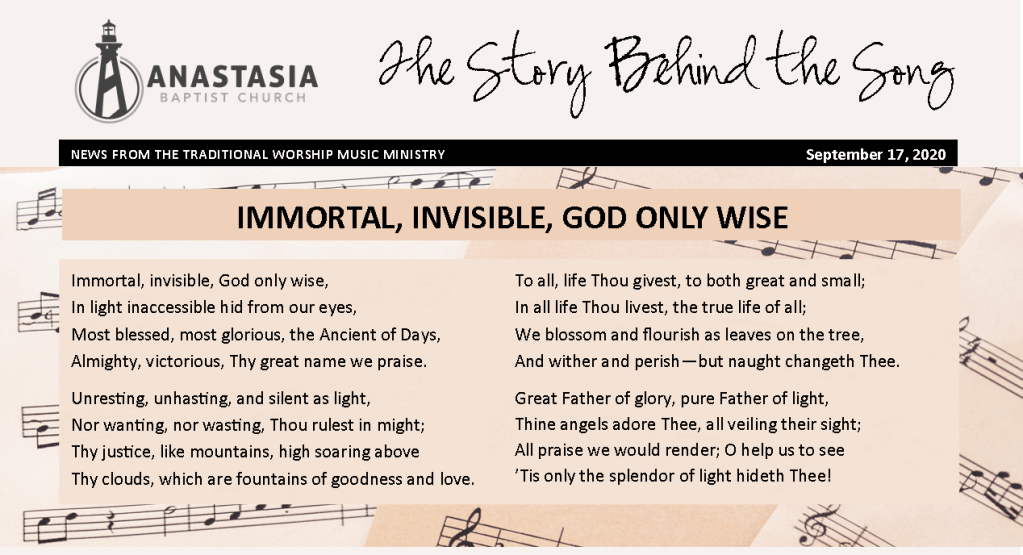
If you take a look in the back of a modern hymnal you’ll probably find an index of authors and composers of the songs. If you look closely, you’ll see that the vast majority of hymn authors have only a single song that has remained in common usage. They may have written many texts, but for most, only one song has stood the test of time. (Of course, there are exceptions, like Fanny J. Crosby, Isaac Watts, Charles Wesley and Keith Getty, who have a dozen or more songs still being sung.)
//
Walter Chalmers Smith (1824-1908) was one such hymn writer. A Scottish Free Church minister, he penned many poems and hymns which were printed in six volumes during his lifetime, but today only one of his works is still sung. But what a song it is!
//
“Immortal, Invisible, God Only Wise” is based on a doxology written by the Apostle Paul and recorded in 1 Timothy 1:17—“Now unto the King eternal, immortal, invisible, the only wise God, be honour and glory for ever and ever. Amen” (KJV). The hymn then goes on to do just that—honor and glorify God—by packing a lot of truth into its few stanzas.
//
Smith starts with a series of descriptors of our great, awe-inspiring God—immortal, invisible, blessed, glorious, almighty, victorious—all of which “ascribe to the Lord the glory due his name” (1 Chronicles 16:29). He also introduces a theme that runs throughout the hymn—“light.” In the four stanzas we commonly sing today, the word appears once each in stanzas 1 and 2, and twice in stanza 4.
//
In the first, the “light inaccessible” that hides Him from our eyes is the blinding glory of the radiance of God. The Old Testament prophet Habakkuk experienced it: “His splendor covered the heavens, and the earth was full of his praise. His brightness was like the light; rays flashed from his hand” (Habakkuk 3:3-4). Peter, James and John encountered the blinding light on the Mount of Transfiguration when they saw Jesus glorified: “…he was transfigured before them, and his face shone like the sun, and his clothes became white as light” (Matthew 17:2). Later, Saul, who became the apostle Paul, was temporarily blinded on the road to Damascus by being in the presence of the risen Jesus (Acts 9:1-9).
//
In stanza 2, Smith highlights in quick succession three attributes of God. His sovereignty, God’s supreme power and authority, is why “Thou rulest in might.” God’s “justice, like mountains” may be a reference to Psalm 36:6, “Thy righteousness is like the great mountains” (KJV). And God’s provision of “clouds, which are fountains of goodness and love,” reminds us that “… your Father who is in heaven [will] give good things to those who ask him!” (Matthew 7:11).
//
Stanza 3 continues to recount Who God is. The first half reinforces the truth that God is the giver of life, a fact repeated many times throughout the Bible (Genesis 2:7, Job 33:4, Acts 17:25, Nehemiah 9:6, 1 Timothy 6:13, etc.) The second half speaks to God’s immutability, His “unchangeableness.” We humans go through stages we surely enjoy (“blossom and flourish”) and some we simply endure (“wither and perish”), but God does not. God does not change, because change means movement from a less desirable state to a greater (improvement) or from a better state to a lesser one (decay). God, however, is now, has always been, and will always be in a state of perfection.
//
“Immortal, Invisible, God Only Wise” closes with a double reference to light and vision. God is a glorious Being Whom James calls “Father of lights” (James 1:17). In a reference to Isaiah 6:2 and the six-winged seraphim (“…with two [the angel] covered his face, and with two he covered his feet, and with two he flew”), Smith writes “Thine angels adore Thee, all veiling their sight.” Why would an angel, which has never known sin, have to cover his face in the presence of God? Because of that same brilliant, blinding radiance of glory we discussed in stanza one. And it’s that same glorious God, before Whom angels bow, Who deserves all the praise we can render.
//
 Anastasia Music