The Story Behind the Song
This song can be viewed on YouTube by clicking here.
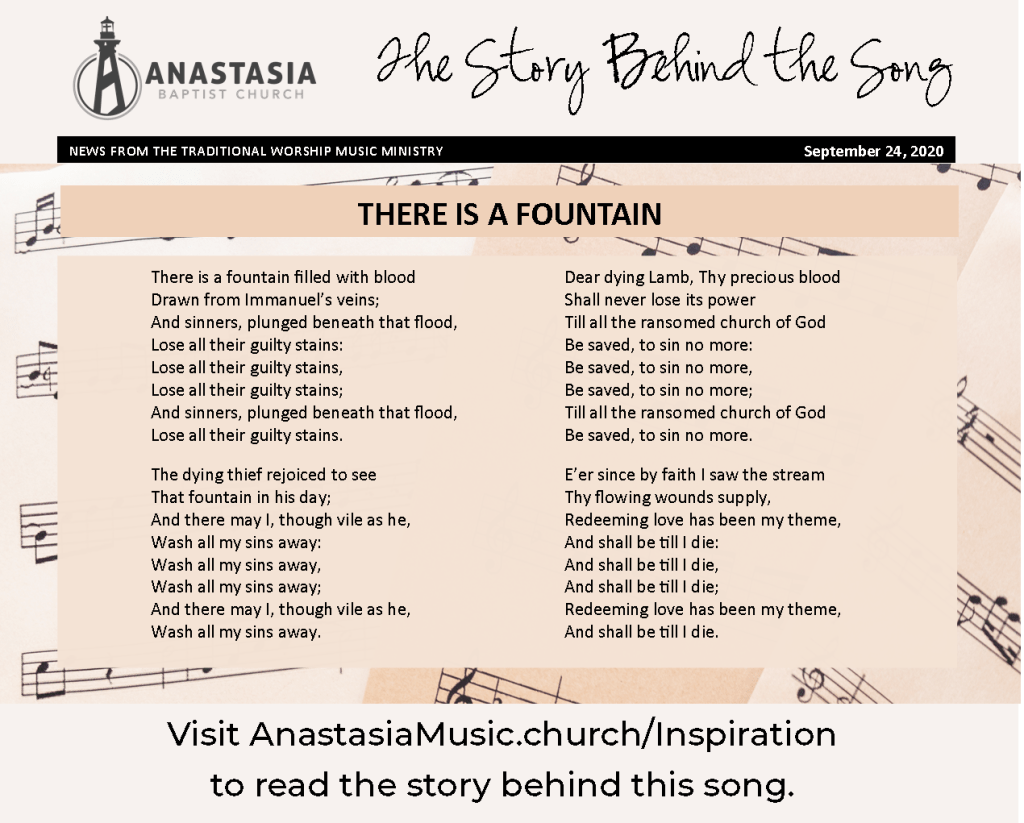
The Old Testament prophet Zechariah foresaw a time when God would miraculously defend Jerusalem and His people there (chapter 12). But that day of awesome triumph would also be a day of awful tragedy as the people were to look “on him whom they have pierced” (12:10). They would “mourn for him, as one mourns for an only child, and weep bitterly over him, as one weeps over a firstborn.” But from that seeming calamity would come healing and cleansing, for “On that day there shall be a fountain opened for the house of David and the inhabitants of Jerusalem, to cleanse them from sin and uncleanness” (13:1).
//
Christians read that prophecy as a foreshadowing of Jesus’ crucifixion and its consequences:
- He was pierced by nails, a crown of thorns and a spear (John 19:34, 37)
- He was mourned and wept for (Mark 16:10)
- His death brought cleansing from sin (1 John 1:7)
//
That passage from Zechariah 13:1 was the fount from which flowed the hymn “There Is a Fountain” by William Cowper. Cowper (1731-1800), lauded by his contemporary Samuel Taylor Coleridge as “the best modern poet,” was probably the most widely read English poet for several decades from the 1780s to the 1830s. During those years, more than 100 editions of his poems were published in Britain and half that number was published in the United States. (Benjamin Franklin even gave his first volume a good review!)
//
But for all his literary success, Cowper struggled with depression and mental instability through most of his adult life, even to the point of attempting suicide multiple times. The first of four major episodes of mental breakdown occurred when he was 21 years old. Not yet a Christian, he recovered (at least he thought so at the time) by a change of scenery, the beauty of nature, and the poetry of George Herbert, a 17th-century Anglican minister and hymn writer.
//
Nine years later he suffered another paralyzing depression that caused him to attempt to end his own life, but providentially was spared, and was committed to the St. Albans Insane Asylum. There he became a patient of Dr. Nathaniel Cotton, a highly regarded physician and successful poet in his own right, but more importantly, a committed Christian. After six months under Dr. Cotton’s care, while walking in the garden, he came across a Bible lying on a bench. In His “Memoirs,” Cowper writes:
“Having found a Bible on the bench in the garden, I opened upon the 11th of St. John, where Lazarus is raised from the dead; and saw so much benevolence, mercy, goodness, and sympathy with miserable men, in our Saviour’s conduct, that I almost shed tears upon the relation; little thinking that it was an exact type of the mercy which Jesus was on the point of extending towards myself. I sighed, and said, ‘Oh, that I had not rejected so good a Redeemer, that I had not forfeited all his favours.’ Thus was my heart softened, though not yet enlightened.”
//
Soon after, however, Cowper’s softened heart became a saved one. He had come across Romans 3:25 which says of Jesus: “…whom God put forward as a propitiation by his blood, to be received by faith. This was to show God’s righteousness, because in his divine forbearance he had passed over former sins.” Upon reading that, Cowper relates: “Immediately I received the strength to believe it, and the full beams of the Sun of Righteousness shone upon me. I saw the sufficiency of the atonement He had made, my pardon sealed in His blood, and all the fullness and completeness of His justification. In a moment I believed, and received the gospel.”
//
About a year later, Cowper left the asylum and began to live with the Unwin family. When the husband and father of the family was tragically killed, the curate of a nearby parish, John Newton (yes, that John Newton, the author of “Amazing Grace”) came to offer ministry. The family was so grateful and impressed that in 1767 they moved to Newton’s town, Olney, to be under his pastoral care.
//
Thus began a 13-year period in which Newton acted as Cowper’s friend, counselor and minister. In 1769 the pastor in Newton asked the poet in Cowper to collaborate with him on a songbook for his church. The resulting 1779 collection, “Olney Hymns,” contains 208 hymns written by John Newton and 68 by William Cowper. In addition to “Amazing Grace,” Newton’s other well-known and still sung hymns from that book are “How Sweet the Name of Jesus Sounds” and “Glorious Things of Thee Are Spoken.” Cowper’s legacy hymns are “O for a Closer Walk with God,” “God Moves in a Mysterious Way,” and “There Is a Fountain.”
//
In a fairy tale or a made-for-TV movie, Cowper’s story would end here with “…and they all lived happily ever after.” But that was not to be. In 1773, in the midst of collaborating with Newton on the hymnal, Cowper sank again into a deep depression, despaired of life and once more repeatedly attempted suicide. (This breakdown is the cause for the decade of time between the beginning and completion of the “Olney Hymns” and for the great disparity in number of songs contributed by the two authors. In the Preface, Newton stated that a secondary reason for the book was “to perpetuate the remembrance of an intimate and endeared friendship” but admitted that “We had not proceeded far upon our proposed plan, before my dear friend was prevented, by a long and affecting indisposition, from affording me any farther assistance.”)
//
It’s hard to comprehend how a talented head that writes beautifully comforting words like “sinners, plunged beneath that flood, lose all their guilty stains” and “there may I…wash all my sins away” could coexist with such a tortured heart. But did not the prophet Elijah who single-handedly stood against the king of Israel, the 450 prophets of Baal and the 400 prophets of Asherah also say, “It is enough; now, O Lord, take away my life, for I am no better than my fathers” (1 Kings 19:4)? And wasn’t it Jonah, who, after witnessing the miracle of Nineveh’s turning to God, said, “O Lord, please take my life from me, for it is better for me to die than to live” (Jonah 4:3)?
//
William Cowper is a prime example of the need to trust our God, not our feelings. The Bible tells us this many times:
“Trust in the Lord with all your heart, and do not lean on your own understanding” (Proverbs 3:5).
“Whoever trusts in his own mind is a fool, but he who walks in wisdom will be delivered” (Proverbs 28:26).
“The heart is deceitful above all things, and desperately sick; who can understand it?” (Jeremiah 17:9).
Faith or feelings? Which will you trust? Which will determine your actions and thoughts? Let Jesus’ words form your decision: “Let not your hearts be troubled. Believe in God; believe also in me” (John 14:1).
//
 Anastasia Music