The Story Behind the Song
This song can be viewed on YouTube by clicking here.
Many stanzas in many hymns are written in a question and answer format. The first part of the stanza poses a question; a later part of the stanza or the refrain answers it.

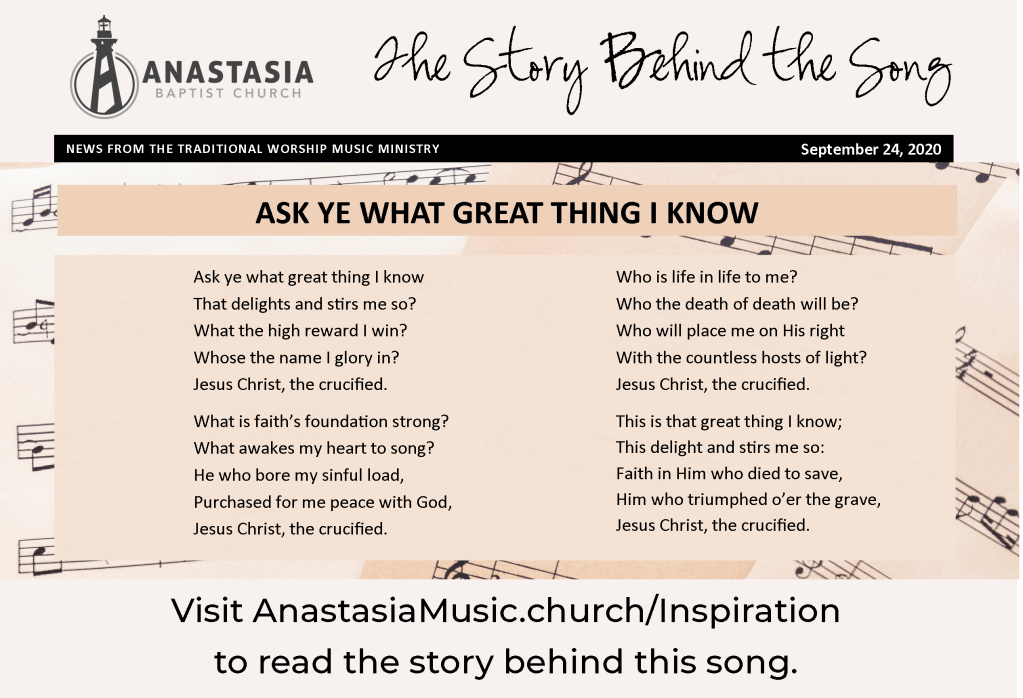
“Ask Ye What Great Thing I Know” falls into that same category of song. It’s comprised of a series of questions that all have the same answer—“Jesus Christ, the crucified.” Although its author wrote more than 500 hymns, only this one remains in common usage.
//
The original German hymn was written by a Lutheran pastor, Johann Christoph Schwedler (1672-1730). The date of the hymn’s writing is unknown since it was not published until 1741, eleven years after Schwedler’s death. He was “a powerful and popular preacher, and peculiarly gifted in prayer.” Upon completing his studies, he was appointed assistant minister at a church in Neiderweise in western Germany in 1698. Schwedler became the main pastor in 1701 and remained at that church for the rest of his life.
//
Recently, we started a new Sunday morning schedule of services here at the island location of Anastasia Baptist Church. Since it’s still prudent to employ social distancing due to COVID-19, we’ve had to do so to accommodate the number of people who wish to gather for worship. One group worships at 8 AM in the Sanctuary; a later one begins at 9 AM in the CLC, followed by another at 10:15, and finally a group at 11 AM back in the Sanctuary. That’s a schedule with which Johann Schwedler would have been familiar. In the church he ministered at for over 30 years, he would sometimes begin services at 5 or 6 AM and continue until 2 or 3 PM, with differing assemblages of worshipers rotating in and out throughout the day.
//
Of the four stanzas of “Ask Ye What Great Thing I Know” that we commonly sing in its English translation, the first three are a series of questions steeped in Biblical references.
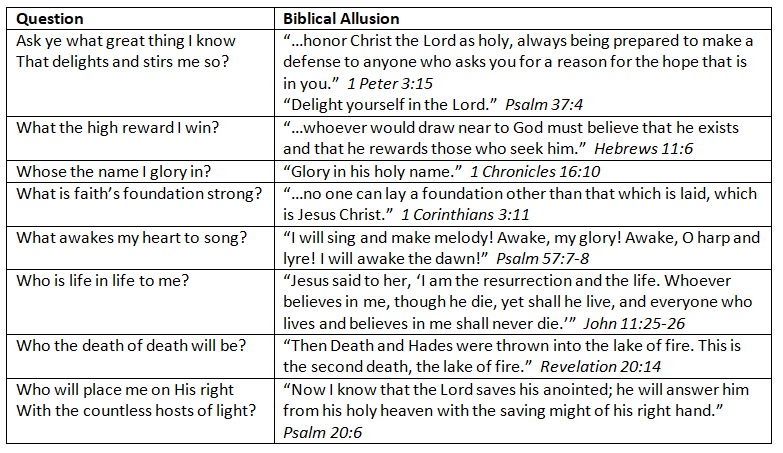
The answer to all those questions is Jesus Christ, the crucified. That short form is the answer given in stanzas 1 and 3; stanza 2 gets an expanded response. Again, Schwedler’s thorough grounding in Scripture is evident.

The last stanza is not a question but a confident assertion. Jesus not only died to provide salvation—“…while we were still sinners, Christ died for us. Since, therefore, we have now been justified by his blood, much more shall we be saved by him from the wrath of God” (Romans 5:8-9). He also rose again in victory—“Why do you seek the living among the dead? He is not here, but has risen” (Luke 24:5-6). And this is the greatest thing a person can know—not merely head-facts about, but the living presence of, the God-Man Jesus!
///
 Anastasia Music