The Story Behind the Song
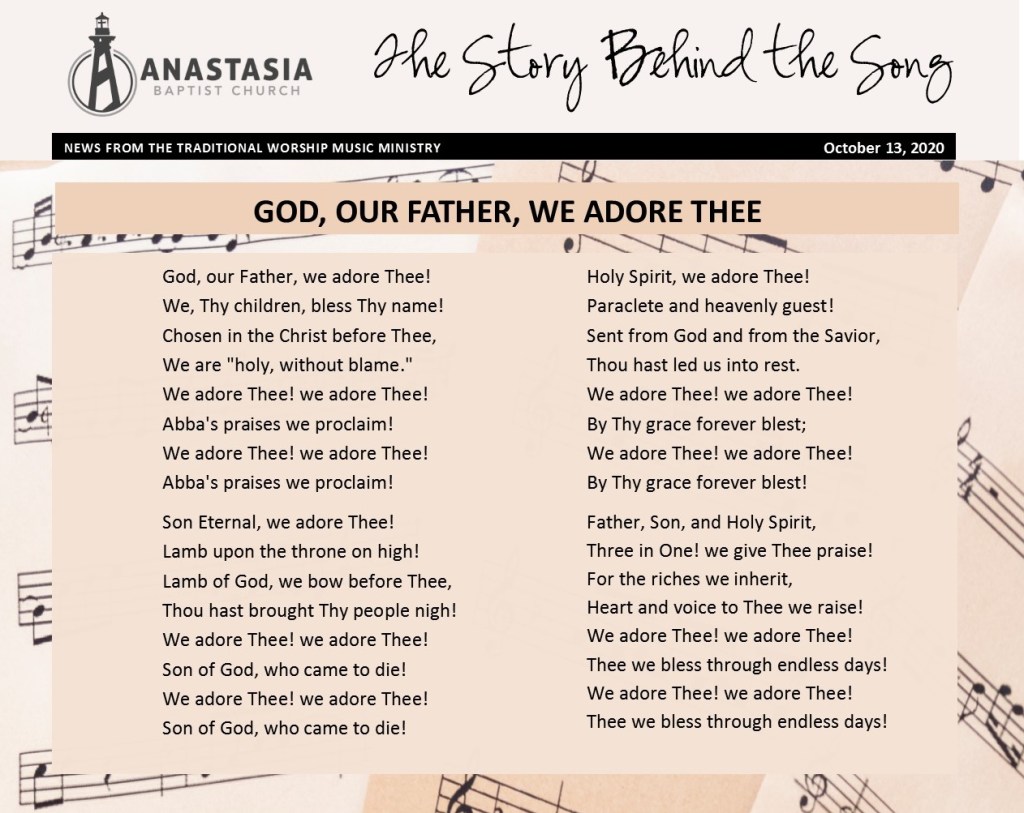
The theological concept of the Trinity is that there is one and only one God Who exists as three persons—Father, Son and Holy Spirit. Each of those Persons of the Godhead is called God in the Bible, and each is worthy of worship. In Galatians 1:1, Paul refers to the Father as God; in John 20:28, Thomas calls Jesus, “My Lord and my God!” and in Acts 5:3-4, Peter asks Ananias, “…why has Satan filled your heart to lie to the Holy Spirit…? You have not lied to man but to God.”
//
Some of our hymns and spiritual songs are written to or about one of the three Persons. “We Praise You, O God, Our Redeemer” and “Be Exalted, O God” are sung to God the Father. “At Calvary” and “Jesus, Keep Me Near the Cross” are sung about and to, respectively, God the Son. “Sweet, Sweet Spirit” and “Breathe on Me, Breath of God” are sung about and to God the Holy Spirit.
//
But some hymns have been written that address each of the three Persons of God in separate stanzas and often have a fourth “summary” stanza. One such example is “God, Our Father, We Adore Thee.” Stanzas 1, 2 and 4 were written by George W. Frazer by 1882, for that’s when they were first published in “Hymns of Praise for the Young.” The hymn was reprinted in the United States in 1904 in “Hymns of Grace and Truth” which was published by Loizeaux Brothers. This version did not have a stanza specifically addressing the Holy Spirit.
//
When Gordon Shorney was contemplating including the hymn in his book “Tabernacle Hymns No. 5,” he asked Alfred Loizeaux if there was a stanza addressed to the Holy Spirit (the author, George W. Frazer, having already died). Since there was not one, Loizeaux wrote several and sent them all to Shorney, who selected the one we currently sing as stanza three.
//
Both Frazer’s and Loizeaux’s stanzas are rich in Biblical allusions. In stanza one, we give praise to God the Father, Who “chose us in him before the foundation of the world, that we should be holy and blameless before him” (Ephesians 1:4). Frazer also references Paul’s words to the church at Galatia: “God has sent the Spirit of his Son into our hearts, crying, “Abba! Father!” (Galatians 4:6).
//
In the second, he focuses on Jesus as the Lamb of God. In the book of Revelation, the apostle John was given a glimpse into Heaven and recorded numerous verses (5:6, 5:13, 6:16, 7:9-10, 7:17, 22:1, 22:3) about a “Lamb upon the throne on high.” Frazer also references Jesus as the Lamb of God, recalling John the Baptist’s words when Jesus came to be baptized: “Behold, the Lamb of God, who takes away the sin of the world!” (John 1:29). Jesus is also called Son of God in stanza two, echoing the declarations of the angel Gabriel to Mary (Luke 1:32, 35), of the disciples when Jesus calmed a raging sea (Matthew 14:33), of Peter when Jesus asked who they thought He was (Matthew 16:16), of the centurion at Jesus’ crucifixion (Matthew 27:54, Mark 15:39), and even of demons (Matthew 8:29, Mark 3:11, Mark 5:7, Luke 4:41).
//
Loizeaux’s stanza addresses the Holy Spirit as “Paraclete and heavenly guest.” The first is a Greek word that means “one called alongside to help” and speaks of the Spirit’s function. In John 14:16, it’s translated as Helper: “And I will ask the Father, and he will give you another Helper, to be with you forever.” The phrase “heavenly guest” refers to the Spirit’s indwelling of believers: “Do you not know that you are God’s temple and that God’s Spirit dwells in you?” (1 Corinthians 3:16).
//
Frazer’s last stanza summarizes the concept of the Trinity—“Father, Son, and Holy Spirit, Three in One!” Where he writes of the “riches we inherit,” he is referring to a passage from Paul’s letter to the church at Ephesus in which all three members of the Godhead are mentioned: “… [May] the God of our Lord Jesus Christ, the Father of glory,…give you the Spirit of wisdom and of revelation in the knowledge of him,…that you may know what is the hope to which he has called you, what are the riches of his glorious inheritance in the saints…” (Ephesians 1:17-18).
//
As we sing this hymn, we’ll repeat the phrase “We adore Thee” nineteen times (and you thought contemporary praise choruses had a lot of repetition!) But let’s commit to singing them not simply as words we vocalize, but as a truth we live out. Let’s be transformed more and more and more into who we are called to be—“a chosen race, a royal priesthood, a holy nation, a people for his own possession” (1 Peter 2:9).
///
 Anastasia Music