The Story Behind the Song
In 1970, the Beatles, those lovable lads from Liverpool, released their final album, “Let It Be.” On it was “The Long and Winding Road,” which became the last of their twenty U.S. number-one hits. It reached that position on June 13 and was on the Billboard Top Ten chart for 10 weeks. Its author, Paul McCartney, said of the work, “It’s a sad song because it’s all about the unattainable; the door you never quite reach.”
//
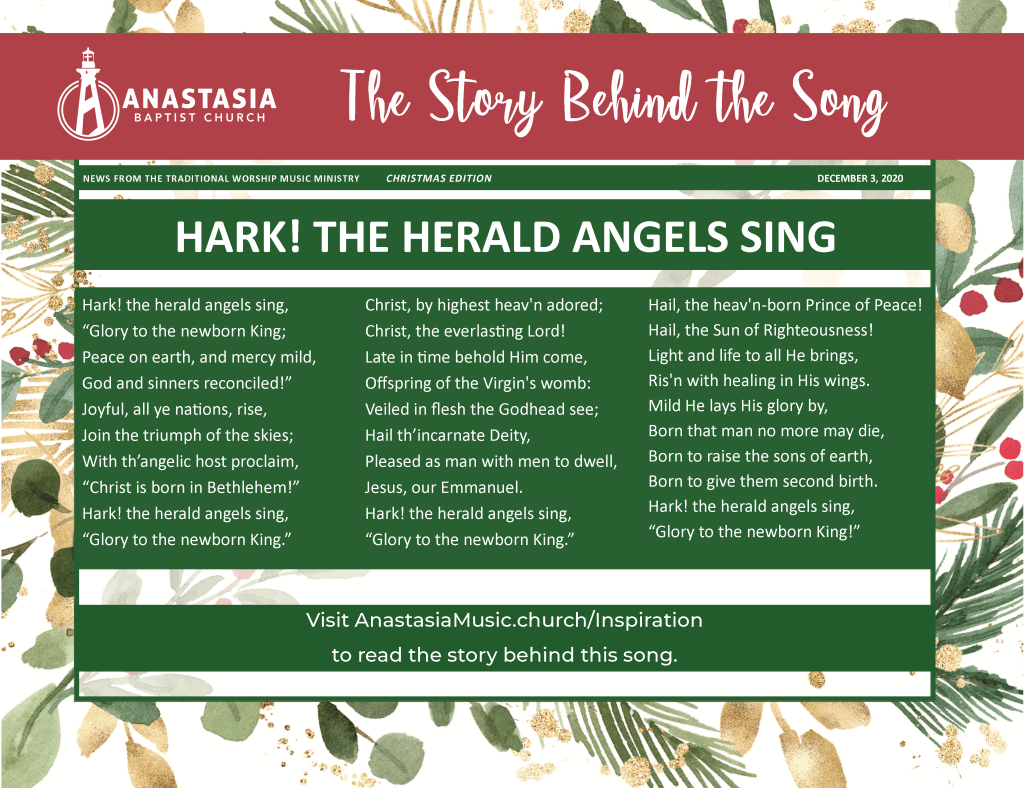
If there ever were a song that experienced its own long and winding road from its original to its final form, but which is definitely not a sad song, it would be “Hark! the Herald Angels Sing.” (For a full treatment of how “Hark How All the Welkin Rings” developed into the beloved carol we sing today, read here.) The Christmas hymn was written by the Anglican minister Charles Wesley (1707-1788) and first appeared in “Hymns and Sacred Poems” (1739). As a pastor, Wesley was immersed in Biblical imagery and allusions and, if we actually listen to what we sing (after all, that’s what “hark” means—“to listen”), we hear a profound gospel message.
//
In the first stanza, Wesley paraphrased the angels’ song found in Luke 2:14 (KJV)—“Glory to God in the highest, and on earth peace, good will toward men.” But he added the phrase, “God and sinners reconciled,” reminding us that the Babe in the manger was born to become the dying Savior on the cross, for “in Christ God was reconciling the world to himself, not counting their trespasses against them” (2 Corinthians 5:19).
//
As we continue to hearken to the song, we’re reminded that Jesus is both fully God and fully human—both the “everlasting Lord” (Genesis 21:33) Who is the “offspring of the Virgin’s womb” (Matthew 1:22-23) as well as a man Who was “veiled in flesh” (Luke 24:36-39) and was “pleased as man with men to dwell” (John 1:14).
//
The last of the three commonly sung stanzas contains references to both Old Testament prophecies and New Testament fulfillments. The prophet Isaiah first wrote of a “Prince of Peace” (Isaiah 9:6) seven centuries before Jesus’ birth. The last prophet before the four hundred years of silence between the Old and New Testaments, Malachi, looked forward to a “Sun of Righteousness” Who would rise “with healing in His wings” (Malachi 4:2). The apostle Paul looked back to Jesus who laid His glory by (Philippians 2:7) so He could offer to sinful humans a second birth (John 3:3).
//
As you sing “Hark! the Herald Angels Sing” during the Christmas season, be sure to truly listen to what you’re singing. Relish the good news that Jesus came and made his home with humanity. Give thanks for the sacrifice He made that gives us the opportunity to be born again. And join your voice with the multitude throughout the last 200 years who have joyfully proclaimed, “Glory to the newborn King!”
///
 Anastasia Music