The Story Behind the Song
James Montgomery (1771-1854) was the son of a Moravian minister. When James was a child, his parents went to the West Indies as missionaries while he and his two younger brothers remained in England at a boarding school. Young James was described as “an indifferent scholar. His teachers made unfavorable reports of his progress.” Although a poor student, he was taken with poetry and began even at a young age to write hymns and poems.
//
Giving up on school around age 14, James worked in small shops and stores until, in 1792, he obtained employment with Joseph Gales, a printer, bookseller, auctioneer, and editor of the “Sheffield Register.” Two years later, when Gales had to flee the country for political reasons, Montgomery became the editor of the newspaper, changed its name to the “Sheffield Iris,” and remained in that position for 31 years, continuously writing and publishing his poetry.
//
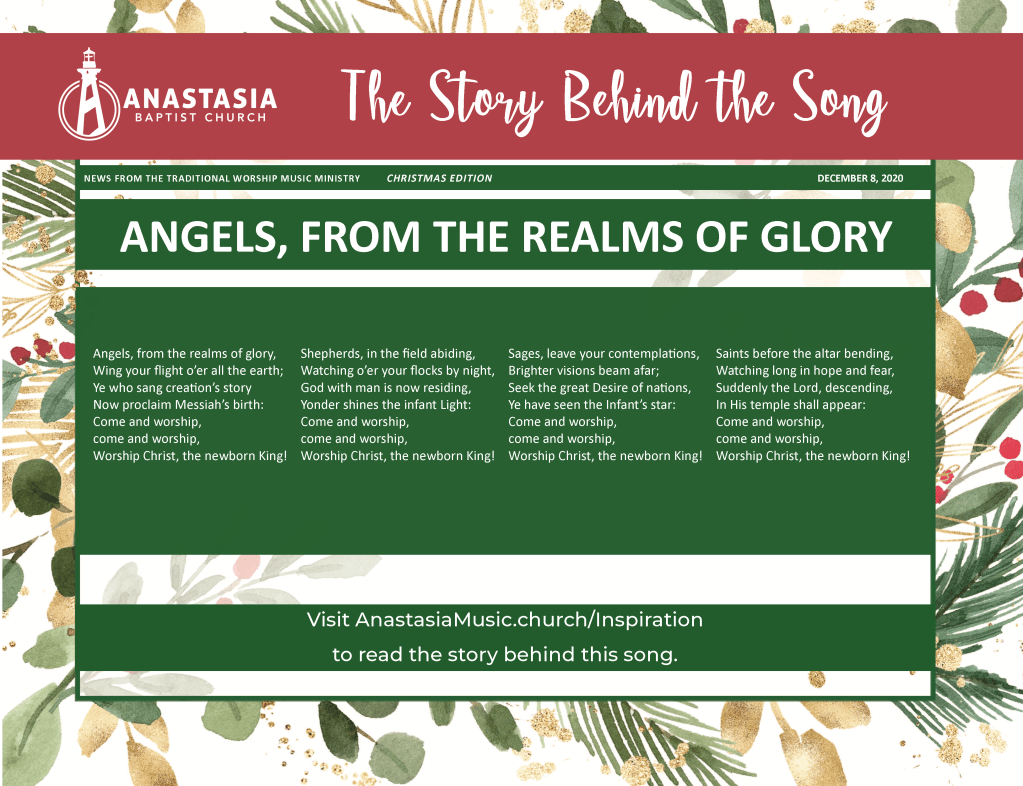
On Christmas Eve of 1816, his work, “Angels, from the Realms of Glory,” was first published in his newspaper. In each of its five stanzas (only four are now commonly used), Montgomery addressed different groups of beings who were involved with or affected by the birth of Jesus, but all of whom should have the same response to the glorious event—“Come and worship, worship Christ, the newborn King!”
//
The first group was the angels of heaven. In Job 38:7, we’re told that, at creation, “the morning stars sang together and all the sons of God shouted for joy.” “Morning stars” and “sons of God” in this passage are interpreted by many Bible scholars to refer to angels. Those same heavenly beings could have been the ones who later appeared to the shepherds in the fields outside Bethlehem to announce the birth of Christ (Luke 2:8-14).
//
The second stanza addresses another group—the shepherds of Luke 2. Montgomery draws two striking distinctions in this stanza. First he contrasts the shepherds’ physical (and social) separation from other humanity (“…in the field abiding”) and the closeness of their God Who “with man is now residing.” He also differentiates between the darkness of the shepherds’ environment (“…watching o’er your flocks by night”) with the infant Light of the World (John 8:12, John 9:5) Who had just been born.
//
The sages of stanza three are more commonly known as the Wise Men or the Magi. They are encouraged to not merely consider the intellectual aspects of Who Jesus is from an ivory tower, but to take action—to seek Jesus, the Desire of nations (Haggai 2:7, KJV). As non-Jews, these sages remind us that Christ came to make the way of salvation available to all the peoples of the earth. Jesus was not just the Desire of Israel, but truly the Desire of nations.
//
The last stanza usually printed in hymnals is the fourth of five Montgomery wrote. In this one, he speaks to “Saints before the altar bending,” i.e. worshipping. He is referencing Simeon and Anna, two devout, elderly Jews who had long been awaiting the appearance of Messiah. When 8-day old Jesus was brought to the Temple in Jerusalem to be presented to the Lord, Simeon gave one of the very first public witnesses to Who Christ is and what He had come to do (Luke 2:22-35). Likewise, Anna also testified, giving thanks to God for Jesus and speaking of Him to “all who were waiting for the redemption of Jerusalem” (Luke 22:36-38).
//
The last stanza is addressed to a group not often found in a Christmas song—sinners.
Sinners, wrung with true repentance,
Doomed for guilt to endless pains,
Justice now revokes your sentence,
Mercy calls you; break your chains.
Come and worship, come and worship,
Worship Christ, the newborn King!
But it is entirely appropriate for Montgomery to include this last classification of people, for it was to and for sinners that Jesus came: “Those who are well have no need of a physician, but those who are sick. I came not to call the righteous, but sinners” (Mark 2:17; see also Matthew 9:13 and Luke 5:32). And that is the reason for angels to rejoice; for shepherds to worship; for sages to seek; and for saints to watch in anticipation—because Jesus has come to break the chains of sin and give true life to all who will accept the offer!
Come and worship!
Come and worship!!
Worship Christ, the newborn King!!!
///
 Anastasia Music