The Story Behind the Song
Keith and Kristyn Getty and Stuart Townend are current-day songwriters, singers and worship leaders. The Gettys hail from Northern Ireland; Townend is from the United Kingdom. But all three are having an immense impact on Christian music and worship in our day all around the world. In 2017, Keith Getty was invested by Queen Elizabeth II as an “Officer of the Order of the British Empire” (OBE) for “services to Music and Modern Hymn Writing.” That same year Stuart Townend received The Thomas Cranmer Award for Worship from the Archbishop of Canterbury “for his outstanding contribution to contemporary worship music.”
//
Together, they have written some of the modern church’s most powerful new hymns:
- “The Power of the Cross (Oh, to See the Dawn)”
- “The Communion Hymn”
- “Speak, O Lord”
- “In Christ Alone (My Hope Is Found)”
- “My Heart Is Filled with Thankfulness”
- “O Church, Arise”
//
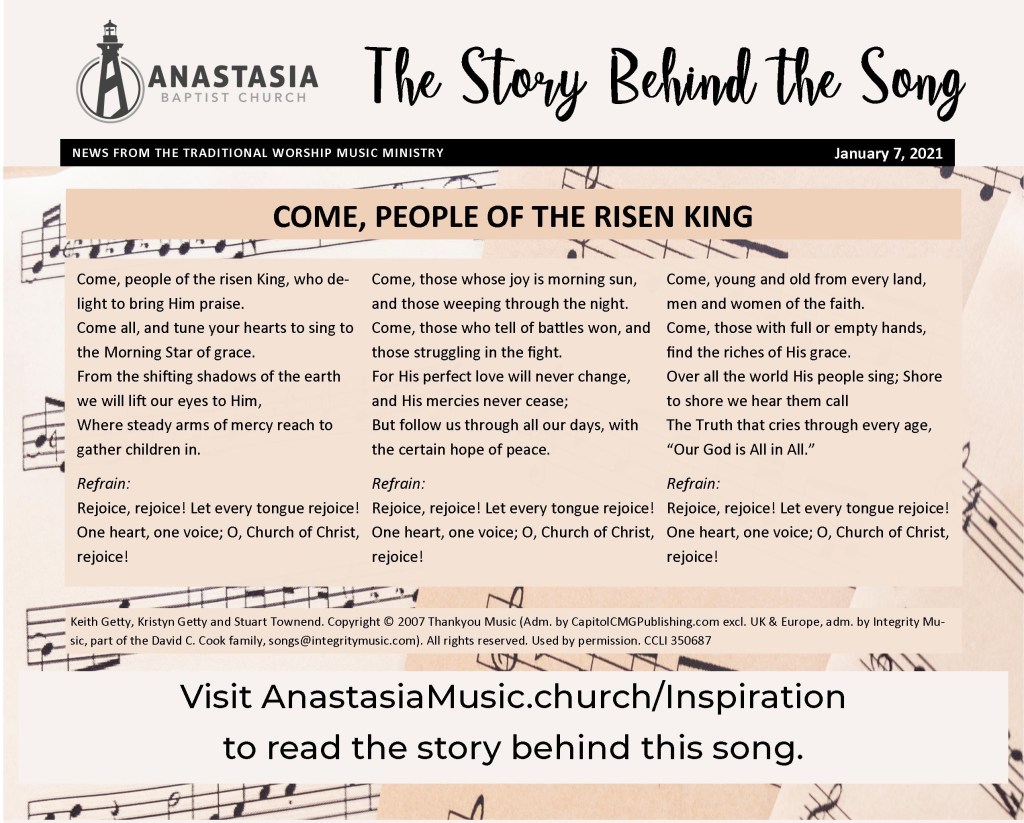
They also came together to create “Come, People of the Risen King.” It’s a Call to Worship, a gathering song that speaks to both the diversity of the members and the unity of purpose in the Body of Christ. (Click here to hear Keith and Kristyn’s interview in which they give some of the backstory for the hymn.)
//
The church of the New Testament era was remarkably diverse. Early believers were of Roman, Greek and Jewish cultural backgrounds. Some were slaves; others were free people. A few were rich by worldly standards, but many more were poor. They were young and old, men and women.
//
Yet, for all their differences, they had an essential unity in their identity as followers of Christ. Paul described that oneness in his letter to the church at Ephesus: “There is one body and one Spirit—just as you were called to the one hope that belongs to your call—one Lord, one faith, one baptism, one God and Father of all, who is over all and through all and in all” (Ephesians 4:4-6).
//
The Gettys and Townend captured both that unity and diversity of believers in the first half of each stanza. In stanza one, Christians are designated as a single, united “people of the risen King” who are “all” to come to worship. In stanzas two and three, they use a series of contrasts to underscore the variety of individuals who comprise the church. Some are enjoying pleasant circumstances and living full and happy lives (“those whose joy is morning sun”) while others are enduring hard times with no relief in sight (“those weeping through the night”). Some have already come through tough times victoriously (“those who tell of battles won”) while others are still in a contest that could go either way (“those struggling in the fight”). Some are younger, some are older; some are men, some are women. Some are wealthy (“those with full…hands”) while others were born with nothing and still have most of it (“those with…empty hands”).
//
The second half of each stanza reminds us of why these dissimilar people come together as one. Stanza one tells us to turn our attention and focus off of the “shifting shadows of the earth” and turn them instead to the One with “steady arms of mercy.” The second stanza encourages us in that, regardless of the current circumstances, God’s love and mercy will not change. And the last is a victorious reaffirmation of the universal truth, “Our God is All in All.”
//
And what should be the response of the people of God to these truths about God? What should be our common action when we gather? Paul wrote, “Rejoice in the Lord always; again I will say, rejoice” (Philippians 4:4). Keith, Kristyn and Stuart wrote, “Rejoice, rejoice! Let every tongue rejoice!” When worshippers today sing this hymn, we join our voices with those of fellow believers around the world and throughout the ages as, with one heart and one voice, the Church of Christ rejoices.
///
 Anastasia Music