The Story Behind the Song
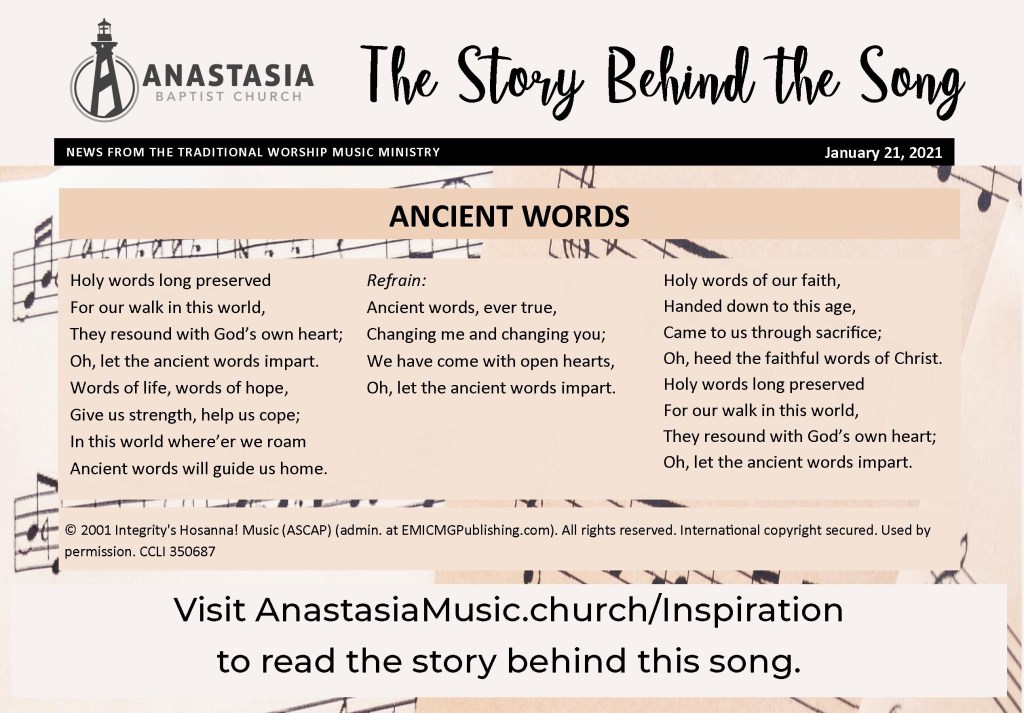
For over forty years Lynn DeShazo (b. 1956) has been active in worship music as a worship leader, songwriter and teacher. She has written well over 350 songs since the early 1980s, with her best-known being “More Precious than Silver.” In an interview, DeShazo said, “My claim-to-fame song is actually ‘More Precious than Silver.’ It’s still the one song of mine that people are most likely to know.” She continued, “But I think ‘Ancient Words’ will surpass it, given enough time.” (As of 2021, “More Precious than Silver” has been published in seven hymnals; “Ancient Words” has been in four).
//
DeShazo said of “Ancient Words”:
I have a couple of songs that were written because the idea was so compelling to me, it wouldn’t go away. “Ancient Words” is one of those songs. As I state in the chapter on “Ancient Words” from my book:
The longer I walk with the Lord, the more love and appreciation I have for the Bible and for those whom God has used throughout the ages to make it available to me. I suppose that was the true impetus for my writing “Ancient Words.”
She concluded: “It’s probably the best ‘bridge builder’ I’ve ever written. People from all types of churches love that song because they love the Scriptures so much.”
//
In her song, the writer uses several phrases to describe the Bible: “holy words,” “ancient words,” “words of life,” “words of hope,” “ever true,” “words of our faith,” “faithful words of Christ.” These phrases speak of the uniqueness of the Scriptures. The Holy Book does not merely contain the words of God—it is the Word of God. It is ancient because He is ancient (Daniel 7:9, Micah 5:2). It is holy because He is holy (Leviticus 11:45). It is words of life that are ever true because He is “the way, and the truth, and the life” (John 14:6).
//
She also refers to the intended purpose of the Bible—to mold and shape and change lives. The Bible is not meant to be merely informational; it is to be transformational. Those holy words were preserved “for our walk in this world”—to light the path on which we walk (Psalm 119:105). In three different letters to three different congregations, Paul exhorted his readers to “walk in a manner worthy” of God (Ephesians 4:1, Colossians 1:9-10, 1 Thessalonians 2:11-12).
//
But sometimes even strong believers will stray and go down paths that are not pleasing to the Lord. In those situations, the “ancient words will guide us home” as we “are being transformed into the same image from one degree of glory to another” (2 Corinthians 3:18).
//
On Paul’s second missionary voyage, he went to Philippi. As he shared God’s word there, a woman named Lydia, whom the Bible describes as a “worshiper of God,” was present. “The Lord opened her heart to pay attention to what was said by Paul” (Acts 16:14) and she placed her trust in Christ and was baptized. DeShazo’s song is a prayer that we will also come to God with open hearts so that we, too, will hear and respond to God’s call.
//
As you read the Bible during your daily quiet times… as you hear God’s Word expounded from the pulpit… as you sing worship songs whose lyrics are drawn mostly from Scripture, allow the words to seep deep into your soul. Think profoundly on them, meditate on them. Permit them to take root in your mind; let the ancient words impart.
///
 Anastasia Music