The Story Behind the Song
In 1513, an ambitious Spanish conquistador, Juan Ponce de León, stepped ashore onto what he mistakenly thought was an island. (As it turns out, it was North America. Oops.) He named his discovery La Florida and claimed it for Spain. Only four years later, in 1517, Martin Luther, “an obscure German monk in unassuming Wittenberg, struck the spark ‘that ignited the flames of the Reformation, a 130-year upheaval in the religious and political life of Western Europe that saw the rise of protesting and dissenting groups of Christians who sought freedom to worship according to what they felt were the Bible’s guidelines, not those of any earthly ecclesiastical authority.’”
//
Both of those events over 500 years ago have ramifications for us today at Anastasia Baptist Church. The first gave us a physical location for our church. The second gave us a more scripturally-based foundation for it.
//
One of the Reformation principles is sola Scriptura (“Scripture alone”), the idea that to the Bible alone should Christians look for guidance for our faith and practice. As early reformers studied the Bible to determine what they should believe and how they should behave, they came to the conclusion that “all the people were to be active participants, not merely passive observers, in the worship experience. The chief avenue of congregational participation came to be song.”
//
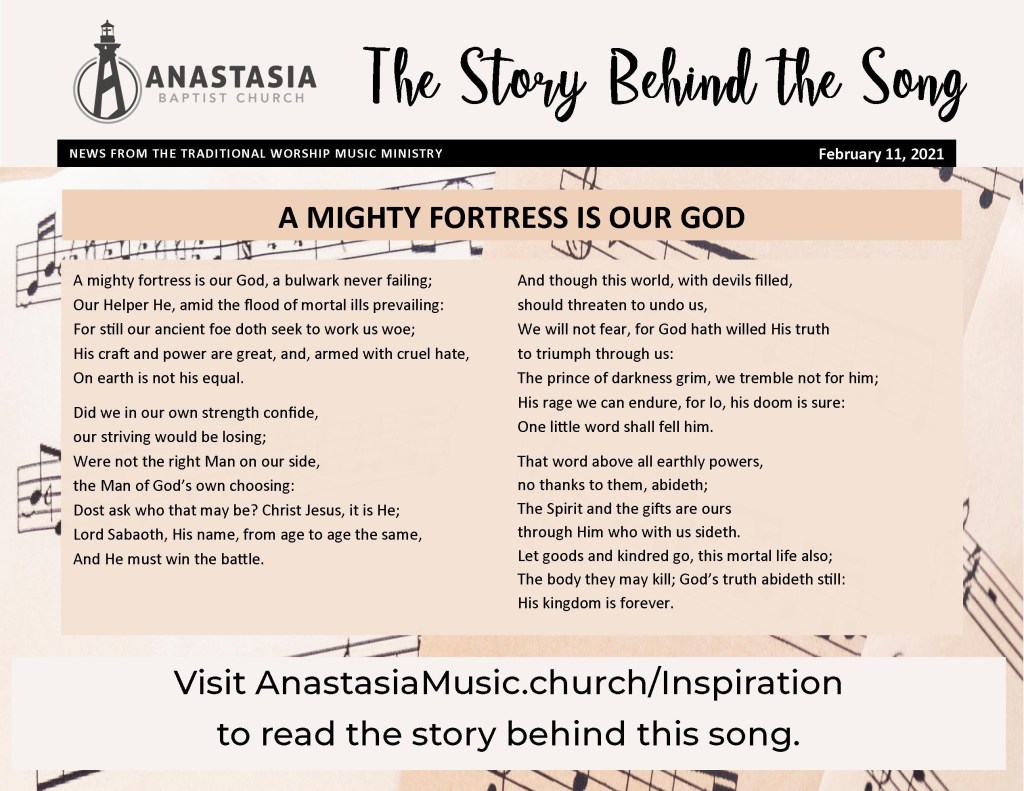
Martin Luther himself took a leading musical role by modifying existing Catholic texts and tunes and even secular melodies, making them usable by Protestant churches. It’s possible that he even wrote new tunes, but it’s an established fact that he wrote 37 new hymn texts. One that we still sing almost five centuries later is “A Mighty Fortress Is Our God.”
//
“Ein’ feste Burg ist unser Gott” (translated into English as “A Mighty Fortress Is Our God” in 1852 by Frederick H. Hedge) was inspired by Luther’s study of Psalm 46, which begins “God is our refuge and strength, a very present help in trouble” and ends with “The Lord of hosts is with us; the God of Jacob is our fortress.” It first was published in 1529 in Wittenberg to the tune we still sing to this day. James Moffatt, the Scottish biblical scholar and translator, said it was the “greatest hymn of the greatest man of the greatest period of German history.”
//
Written by a pastor with a high view of Scripture, the hymn has many allusions to Biblical passages. God is described as a “mighty fortress” and a “bulwark,” both positions of strength that can withstand repeated assaults. And those assaults come from Satan, the “ancient foe” (“the dragon, that ancient serpent, who is the devil and Satan”—Revelation 20:2) and the “prince of darkness” (“We do not wrestle against flesh and blood, but against the rulers, against the authorities, against the cosmic powers over this present darkness, against the spiritual forces of evil in the heavenly places.”—Ephesians 6:12).
//
Luther reminds us that we can’t wage war against Satan “in our own strength”; if we tried, “our striving would be losing.” Instead, Jesus Himself fights on our behalf. “Lord Sabaoth” means God of Hosts or God of Armies and is sometimes translated as “Almighty” (see Romans 9:29 and James 5:4). Jesus is the mighty God who commands the armies of Heaven (see Revelation 19:11-16) and Who will win the final victory over Satan (see Revelation 19:19-20:10).
//
“A Mighty Fortress Is Our God” is a hymn of great comfort. It reminds us of the things that are temporary and the things that last. Some of the things that are passing we are only too happy to see go away—“the flood of mortal ills prevailing” and the attacks of Satan. Other transitory things we give up only reluctantly—“goods and kindred…this mortal life also.” But standing above and beyond this “light momentary affliction is…an eternal weight of glory beyond all comparison” (2 Corinthians 4:17). That which stands firm, that which is permanent, that which never fails, is God. It is He and His truth and His kingdom that will ultimately stand, for “A Mighty Fortress Is Our God”!
///
 Anastasia Music