The Story Behind the Song
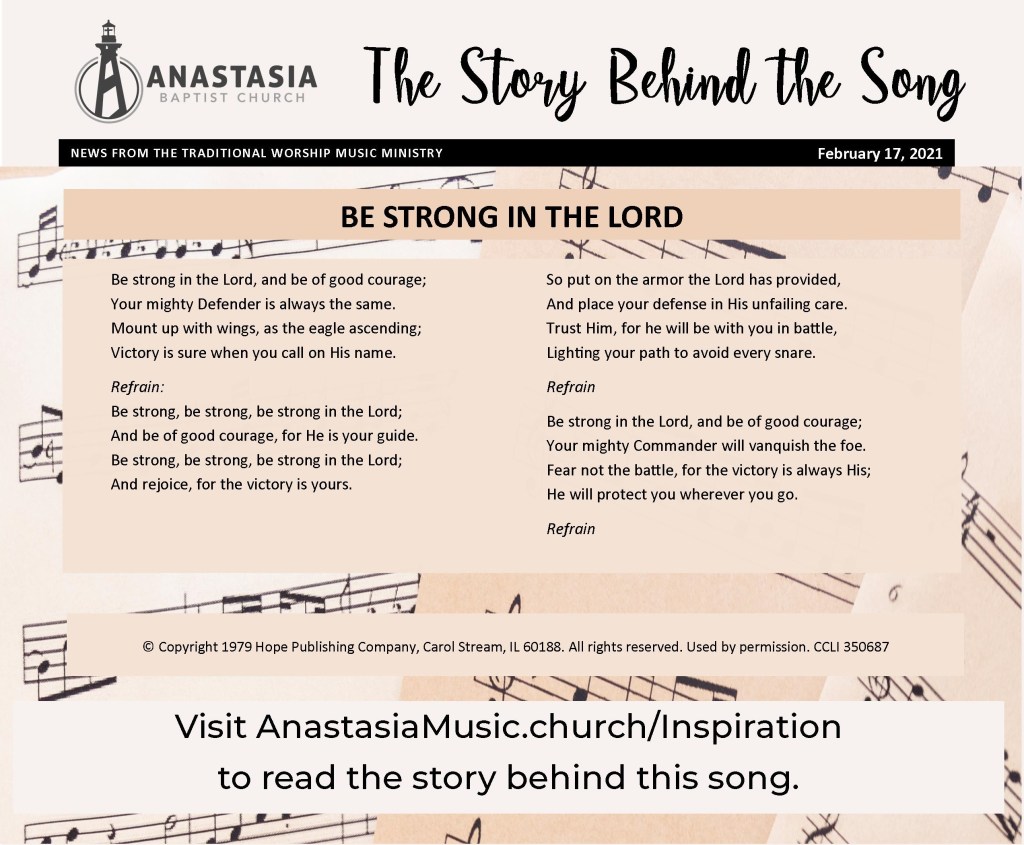
Strength and courage. Those qualities are addressed many times in scripture. In the English Standard Version (ESV) of the Bible, there are 28 verses that contain the command to “Be strong.” It was spoken by Moses to the people of Israel (Deuteronomy 11:8, 31:6) and to Joshua (Deuteronomy 31:7). God charged Joshua four times to “be strong” (Deuteronomy 31:23; Joshua 1:6, 1:7, 1:9) and the people of Israel encouraged their new leader with it (Joshua 1:18).
Throughout the history of the nation of Israel, the kings and commanders of its army buoyed their soldiers with the admonition to be strong—Joshua (Joshua 10:25), David (2 Samuel 2:7), Joab (1 Chronicles 19:13), Hezekiah (2 Chronicles 32:7). An unnamed prophet of God encouraged King Amaziah to be “strong for the battle” when he was threatened by Edom (2 Chronicles 25:8). When God told David that his son, not he himself, would build the first temple, David counseled Solomon repeatedly to be strong (1 Chronicles 22:13, 28:10, 28:20).
When David knew his time on earth was short and that Solomon was soon to reign he advised his son to “Be strong, and show yourself a man” (1 Kings 2:2). The prophets Ezra and Daniel, facing daunting tasks, were told to be strong (Ezra 10:4; Daniel 10:19). So was the governor of Judah, Zerubbabel, and the high priest, Joshua (Haggai 2:4).
But it wasn’t only the great people of the Bible—kings, priests, prophets, leaders—who were commanded to be strong. The common people were exhorted over and over to be strong in the Lord. David wrote it in psalms (Psalm 27:14, 31:24), prophets like Isaiah and Haggai and Zechariah preached it (Isaiah 35:4; Haggai 2:4; Zechariah 8:9, 8:13), ordinary people encouraged it (Isaiah 41:6) and Paul wrote it in letters to the early churches (1 Corinthians 16:13; Ephesians 6:10).
There are also 21 verses in the ESV that command courage—“Be courageous” or “Be very courageous” (12 verses), “Take courage” (5 verses), “Be of good courage” (3 verses) and “Deal courageously” (1 verse). Both individuals and groups were directed to exhibit courage when they needed to reconnoiter and conquer the Promised Land (Numbers 13:20; Deuteronomy 31:6, 31:7, 31:23; Joshua 1:6, 1:7, 1:9, 1:18, 10:25). Soldiers and their commanders going into battle were inspired to courage (1 Samuel 4:9; 2 Samuel 10:12, 13:28; 2 Chronicles 32:7). Leaders were exhorted to be courageous as they fulfilled their responsibilities (1 Chronicles 22:13, 28:20; 2 Chronicles 15:7, 19:11; Daniel 10:19; Acts 23:11).
The two qualities of strength and courage are often linked in the Bible, like two sides of the same coin. Six times, Joshua is told to “Be strong and courageous” (Deuteronomy 31:7, 31:23; Joshua 1:6, 1:7, 1:9, 1:18). Moses says it to all of Israel (Deuteronomy 31:6), and Joshua to his army (Joshua 10:25). David commands his son Solomon to “Be strong and courageous” in the building of the temple (1 Chronicles 22:13, 28:20) and in two psalms he writes “Be strong, and let your heart take courage” (Psalm 27:14, 31:24). An angel tells the prophet Daniel, “…be strong and of good courage” (Daniel 10:19).
Linda Lee Johnson (b. 1947) is a current hymn writer who lives in Castro Valley, CA. She began writing song lyrics in 1978, and one of her early works was Be Strong in the Lord. It was written on a plane in 1979 as she flew to her grandfather’s funeral. In the choral anthem and the hymn that was derived from it, Johnson captures the Biblical teaching that courage and strength are both needed to accomplish God-sized tasks. As Martin Luther wrote in A Mighty Fortress Is Our God, “Did we in our own strength confide, our striving would be losing.” But Luther and Johnson both recognize, as did the Apostle Paul, that only by abandoning our own human, weak efforts can we find true strength in Jesus, Who said, “My grace is sufficient for you, for my power is made perfect in weakness” (2 Corinthians 12:9).
In Be Strong in the Lord, there are many robust, active commands—“be strong,” “be of good courage,” “mount up,” “rejoice,” “put on the armor,” “place your defense,” “trust Him,” “fear not.” All of them are reminders that the Christian life is not one of passivity, in which we simply sit around and wait for situations to occur. They also remind us that we don’t go out to face those circumstances trusting in our own abilities. We’re told to “be strong,” for instance, but not in our own strength, but “in the Lord.” We’re told to “fear not,” not because we are intrepid warriors, but because “the victory is always His.” We can “be of good courage” because “He is your guide.” We can place our defense in God’s hands because of “His unfailing care.” We can “mount up with wings, as the eagle” because “they who wait for the Lord shall renew their strength; …they shall run and not be weary; they shall walk and not faint” (Isaiah 40:31). We can “put on the armor” because “the Lord has provided” it in the first place (Ephesians 6:10-18). We can “trust Him” to be with us in battle, for He said, “I will never leave you nor forsake you” (Hebrews 13:5).
Be strong, then, man or woman of God. Be of good courage. It’s true that “we do not wrestle against flesh and blood, but against the rulers, against the authorities, against the cosmic powers over this present darkness, against the spiritual forces of evil in the heavenly places” (Ephesians 6:12). But it’s also true that “he who is in you is greater than he who is in the world” (1 John 4:4). So “…let not your heart faint. Do not fear or panic or be in dread of them, for the Lord your God is he who goes with you to fight for you against your enemies, to give you the victory” (Deuteronomy 20:3-4). Now rejoice, because the battle is already won and the victory is already secured!
///
 Anastasia Music