The Story Behind the Song
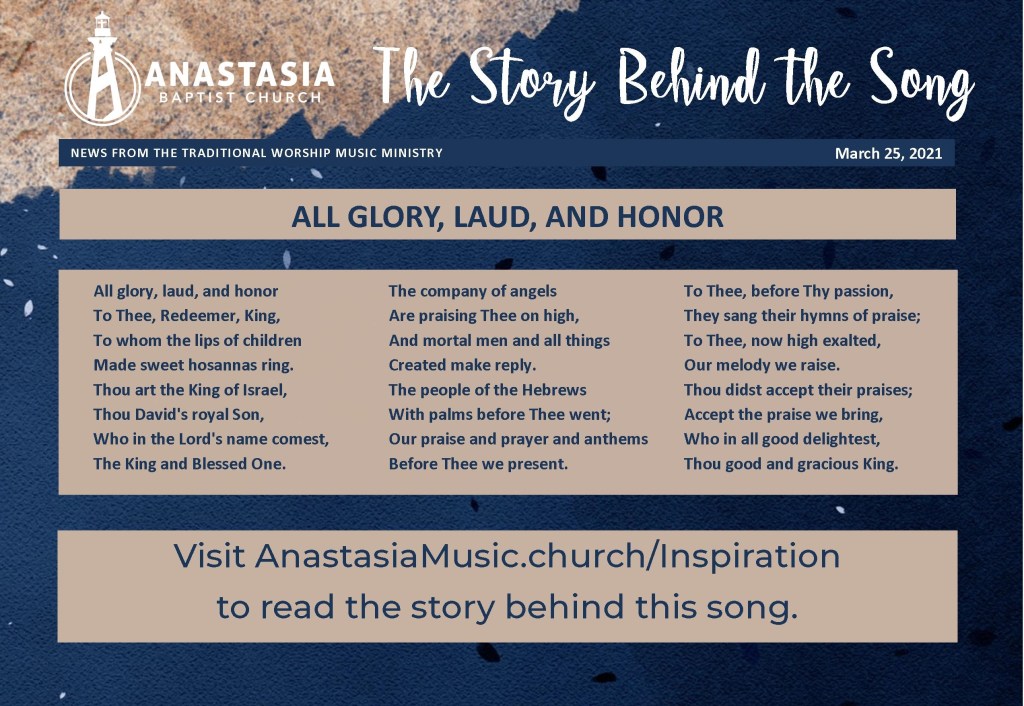
All Glory, Laud, and Honor, possibly the best known of all Palm Sunday hymns, is one of the oldest Christian songs still being sung, even 1,200 years after it first appeared. It was written in Latin (Gloria, laus et honor) around 818-821 AD and originally consisted of 78 lines of text. Its author is Theodulph of Orleans (ca. 760-821). He was attached to the court of Charlemagne, the man who ruled much of Western Europe from the late 700s through the early 800s and would be crowned the first emperor of the Holy Roman Empire in 800. Charlemagne made Theodulph the bishop of Orleans, France around 798.
//
When Charlemagne died in 814, his son Louis I took the throne. Three years later, Bernard of Italy led an unsuccessful rebellion against Louis. Although Theodulph protested his innocence until his death, Louis imprisoned Theodulph on suspicion that he had supported Bernard and the insurrection.
//
Sometime while in prison from 818 until his death in 821, Theodulph wrote Gloria, laus et honor. After he died, the massive poem was shortened and became a processional hymn (one sung while people move from one place to another) for Palm Sunday.
//
A millennium(!) after Theodulph went into prison, John Mason Neale (1818-1866) was born. He became a great admirer of the hymnody of the early centuries of Christianity and translated many Greek and Latin hymns into English, thus restoring to modern believers many treasures of the ancient Church. In 1851, he produced Mediaeval Hymns and Sequences, a collection of translations of songs from the Middle Ages, including Glory, and honour, and laud be to Thee, King Christ the Redeemer!, his version in English of Theodulph’s Gloria, laus et honor. He later reworked it into the hymn we sing today, All Glory, Laud, and Honor.
//
In the three stanzas we sing today, Theodulph and Neale retell some of the important points of the Triumphal Entry, that moment we celebrate as Palm Sunday when Jesus entered Jerusalem days before he would be crucified.
| …sweet hosannas ring. Thou art the King of Israel, Thou David’s royal Son, Who in the Lord’s name comest,… | “Hosanna! Blessed is he who comes in the name of the Lord, even the King of Israel!” (John 12:13b) “Hosanna to the Son of David! Blessed is he who comes in the name of the Lord! Hosanna in the highest!” (Matthew 21:9) |
| The company of angels Are praising Thee on high… | I heard around the throne…the voice of many angels, numbering myriads of myriads and thousands of thousands, saying with a loud voice, “Worthy is the Lamb who was slain…” (Revelation 5:11-12) |
| And mortal men and all things Created make reply. | I heard every creature in heaven and on earth and under the earth and in the sea, and all that is in them, saying, “To him who sits on the throne and to the Lamb be blessing and honor and glory and might forever and ever!” (Revelation 5:13) |
| The people of the Hebrews With palms before Thee went… | “So they took branches of palm trees and went out to meet him…” (John 12:13a) “…others cut branches from the trees and spread them on the road.” (Matthew 21:8) |
But the hymn is not just about recalling what ancient people did over two thousand years ago. It also invites us to join in the celebration today! We are encouraged to bring “our praise and prayer and anthems,” not merely remember theirs. We’re invited to raise “our melody” and not just reminisce about their hymns of praise. We are challenged to make “the praise we bring” in our day a sacrifice worthy of acceptance by our “good and gracious King.”
//
To truly revel in the majesty of the resurrection, we must first realize the misery of the crucifixion. That misery is multiplied when we come to grips with the fact that that some of the same people who were shouting “Hosanna! Hosanna!” on Palm Sunday were crying out “Crucify! Crucify!” just days later. People are fickle and forgetful, when we should be faithful. All Glory, Laud, and Honor is not just a title of a hymn; it’s a reminder of what is rightfully due to Him Who endured the cross, Who despised the shame, Who conquered death, and Who will return in the ultimate Triumphal (Re-)Entry! “All glory, laud, and honor to Thee, Redeemer, King!”
///
 Anastasia Music