The Story Behind the Song
In today’s parlance, a side hustle is any type of employment or paid activity outside of your regular, main occupation. It’s usually something a person is passionate about, rather than just a way to make money.
//
Robert Lowry (1826-1899) was a 19th-century Baptist pastor with a musical side hustle. In Biography of Gospel Song and Hymn Writers, he was described as “a man of rare administrative ability, a most excellent preacher, a thorough Bible student, and whether in the pulpit or upon the platform, always a brilliant and interesting speaker. He was of a genial and pleasing disposition, and a high sense of humor was one of his most striking characteristics. Very few men had greater ability in painting pictures from the imagination. He could thrill an audience with his vivid descriptions, inspiring others with the same thoughts that inspired him.”
//
In addition to his excellent qualities as a pastor, Lowry was also musically inclined. Beginning in 1868, he served for over two decades as editor of Sunday school song collections for the leading publisher of such material in the United States, Biglow and Main, during the gospel song explosion of the post-Civil War era. He also wrote both words and music for many gospel songs, including Nothing but the Blood, Shall We Gather at the River, and Christ Arose (AKA Low in the Grave He Lay).
//
Lowry composed tunes for others’ words as well, such as Isaac Watts’ We’re Marching to Zion, Annie S. Hawks’ I Need Thee Every Hour, Fanny J. Crosby’s All the Way My Savior Leads Me, Sylvanus D. Phelps’ Something for Thee, and W.O. Cushing’s Down in the Valley With My Savior I Would Go (AKA Follow On). (Of the last, its author said, “It was written with the prayer and the hope that some heart might by it be led to give up all for Christ. Much of the power and usefulness of the hymn, however, are due to Mr. Lowry, who put it into song.”)
//
Christ Arose has become one of this country’s most popular Easter songs in evangelical churches. In 2020, Sharron Lyon, who served First Baptist Church of Nashville as organist for 40 years, said she believed that Christ Arose and Christ the Lord Is Risen Today had been sung in that church on Easter Sunday for more than 75 years.
//
In the song, Lowry skillfully paints two opposing pictures with words and music. In one scene (the three stanzas), there is death and despair, communicated musically by a slow tempo, mostly step-wise movement, basic rhythms of quarter notes and half notes, and a narrow range of pitches. The other scene, the chorus, is a complete contrast. Here the emphasis is on life and rejoicing. The tempo is immediately faster, the pitches climb the ladder from low to high as the tune itself rises, the rhythms take on the typical “gospel gallop” of dotted eighth-sixteenth notes, and the tune encompasses almost an octave and a half.
//
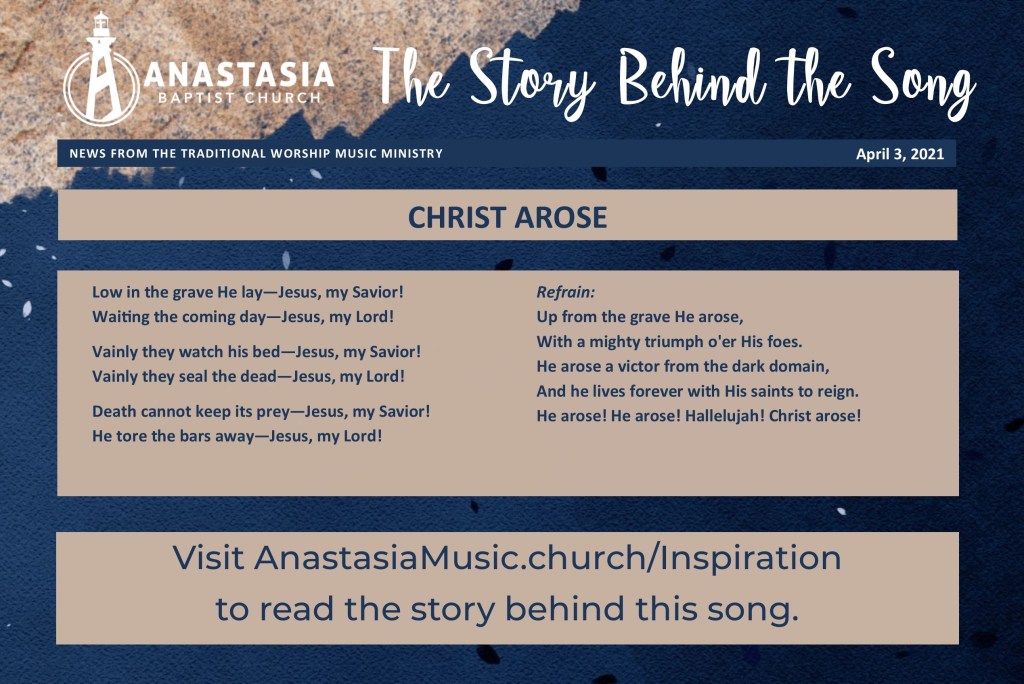
Robert Lowry once said, “I would rather preach a gospel sermon to an appreciative, receptive congregation than write a hymn,”[1] but it’s his hymns, not his sermons, that continue to speak today, more than a century after his death. But that’s because his hymns speak of One who not only died two thousand years ago but was resurrected and lives to this day—Jesus, Who “arose a victor from the dark domain, and…lives forever with His saints to reign.” Hallelujah! Christ arose!
[1] https://hymnary.org/person/Lowry_Robert, accessed 4/1/2021.
///
 Anastasia Music