The Story Behind the Song
Benjamin Keach (1640-1704) was a pastor of an English Baptist church in London, who, in 1673, did something that was considered brave and daring by some, and quite scandalous by others. (If you are easily shocked, perhaps you should just skip this edition of “The Story Behind the Song.” You’ve been warned.) This radical thing he led his church to do flew in the face of prevailing thought. Keach and most of his church stood firm despite the backlash, but some members did indeed leave the church over their pastor’s actions. Rev. Keach had, depending on one’s viewpoint, either the gall and audacity, or the courage and conviction, to lead his congregation in (gasp!) singing a hymn at the close of the Lord’s Supper!
//
Why was it a turning point in Baptist music and worship history? And why did it cause such a stir? Because prior to this, Baptist churches chiefly followed the lead of the reformer John Calvin, who rejected the use of organs, choirs and “hymns of human composure” in worship, and allowed only the singing of Scripture (primarily the Psalms) in unison and without instrumental accompaniment. The door that Benjamin Keach first nudged ajar was flung wide open by another pastor who was born the year after Keach’s revolutionary change in worship. Isaac Watts (1674-1748), destined to be known as the “Father of English Hymnody,” was to become “the one man who most changed the course of English-speaking congregational praise.”
//
But before he became the Father of English Hymnody, young Isaac was the precocious son of a dissenting (non-Anglican) preacher with a flair for language. “He was learning Latin by age 4, Greek at 9, French (which he took up to converse with his refugee neighbors) at 11, and Hebrew at 13.” As a teen, he complained to his father about the doleful psalm singing in church and blamed it on the songs. When his father challenged him to write something better, young Isaac responded with his first hymn, “Behold the Glories of the Lamb,” the first stanza of which is:
Behold the glories of the Lamb
Amidst His Father’s throne!
Prepare new honors for His name,
And songs before unknown.
//
And that’s just what Watts did for the rest of his life; he prepared new honors for God by writing a new type of song. Since the Reformation began (ignited by Martin Luther’s nailing of the Ninety-Five Theses on the castle church’s door at Wittenberg in 1517), the two major streams of Reformed church song—Luther’s chorales and Calvin’s psalms—had developed simultaneously but separately, like two forks of a river separated by an expanse of land. Watts blended the devotional lyric poetry of the former with the Scripture paraphrase of the latter to produce a new type of church song, the classic English hymn.
//
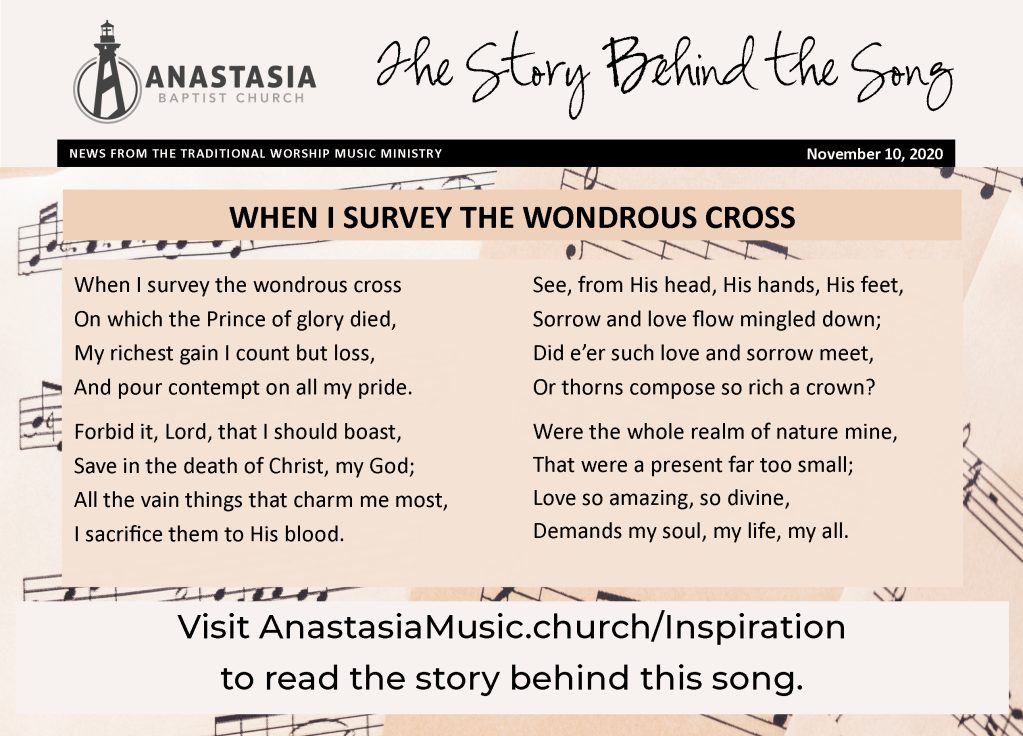
The model that Watts perfected influenced the form and content of English hymns for years. His songs used simple, straight-forward language, words that everyone could understand. The opening phrase acted as a headline that proclaimed the theme of the hymn—for example, “When I survey the wondrous cross.” The following phrases and stanzas then expanded upon that theme. In our focal hymn, we see through Watts’ eyes what he saw when contemplating the cross—he saw Jesus, the “Prince of glory,” and by contrast, himself, who had no grounds for pride. Due to Jesus’ ultimate sacrifice, he saw the need to sacrifice “all the vain things that charm me most.” He saw both the love of Jesus that caused Him to give His life, and the sorrow that that giving inflicted upon Him.
//
Isaac Watts’ hymns usually contained a dramatic climax. In “When I Survey the Wondrous Cross,” the hymn ends with a clear call to action. Because of His “love so amazing, so divine” that was demonstrated by Jesus’ sacrifice, our only appropriate response is to give to Him our souls, our lives, our all!
//
Almost three and a half centuries after he was born, Isaac Watts is still a prominent voice in Christian hymnody. In the most recent edition of “Baptist Hymnal” (2008), he is represented by almost a dozen songs:
- “Alas, and Did My Savior Bleed” (given a new tune and with an added chorus as “At the Cross”)
- “Am I a Soldier of the Cross”
- “From All That Dwell Below the Skies”
- “I Sing the Mighty Power of God” (words fitted to two different tunes)
- “Jesus Shall Reign”
- “Joy to the World! The Lord Is Come”
- “O God, Our Help in Ages Past”
- “This Is the Day the Lord Has Made”
- “We’re Marching to Zion”
- “When I Survey the Wondrous Cross” (words fitted to two different tunes)
- “The Wonderful Cross” (the previous hymn with an added chorus)
//
But Isaac Watts’ greatest impact was not the songs he wrote but the position he created for singing, a place that remains to this day. “Keach and other pioneers sowed the seed and watered the soil, but Watts brought congregational hymn singing to full flower. Before him, it was the exception rather than the rule. After him, it was common practice among Baptists and Independents.”
///
 Anastasia Music