The Story Behind the Song
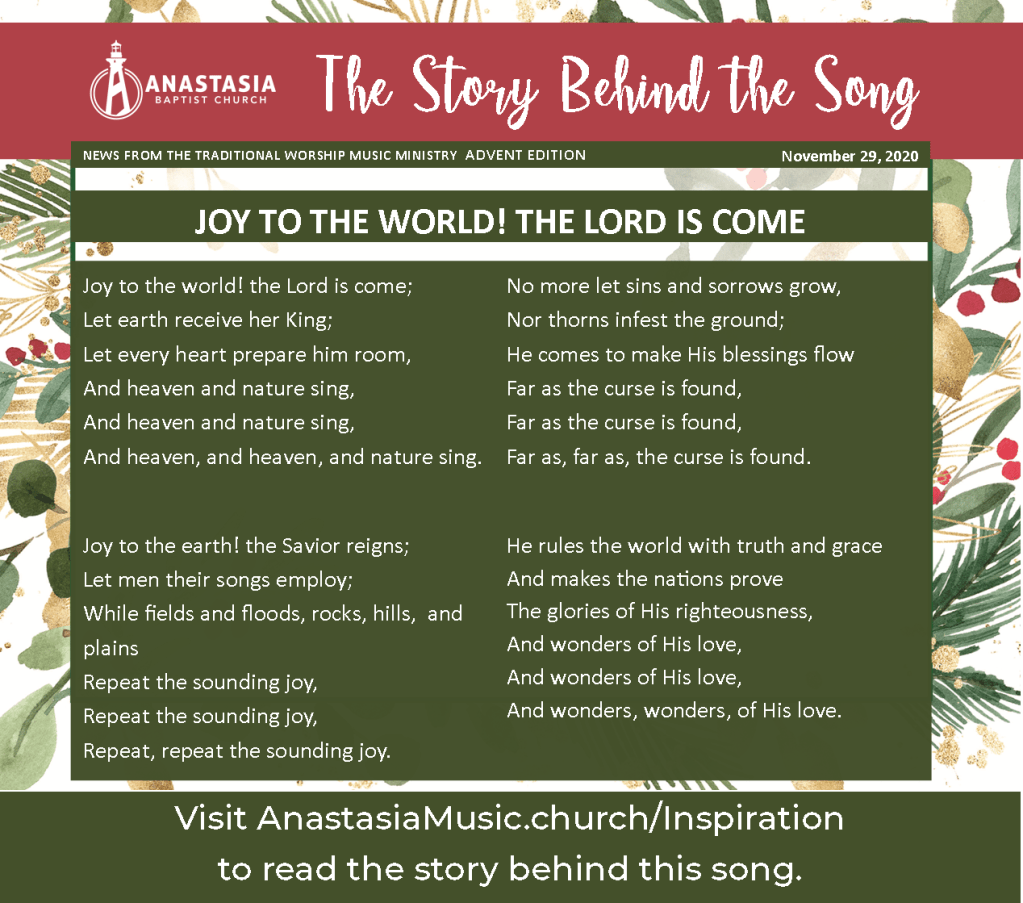
First published in 1719, “Joy to the World! The Lord Is Come” is still going strong after three centuries of continuous use. In 2009, the Dictionary of North American Hymnology reported that the song is the most-published Christmas hymn in the United States and Canada, having appeared in 1,387 hymnals. (For comparison, the next most popular carol, “Hark! The Herald Angels Sing,” has been published in 974 songbooks.) Originally written in English, it has been translated into Latin, Chinese, German, Korean, Spanish and Welsh. It truly is a song that speaks joy to the (entire) world!
//
Its author is Isaac Watts, whose enormous contribution to English hymnody has been detailed in The Story Behind the Song for “When I Survey the Wondrous Cross.” In his day, most churches in England, if they sang at all, sang only the Psalms from the Bible, not “hymns of human composure.” But Watts (1674-1748) believed that “authentic Christian praise could only be expressed through newly written words. Mere repetition of Scriptural text was insufficient.” He also held that if the Psalms were to be sung by Christian churches, they should be reworded to reflect a distinctly Christocentric perspective.
//
In 1719, Watts published “The Psalms of David Imitated in the Language of the New Testament and Applied to the Christian State and Worship,” a collection of texts in which he paraphrased most of the 150 Biblical psalms. In its preface, he explained his “own design, which is this, To accommodate the book of Psalms to Christian worship.” In other words, he restated the original psalms “to make them always speak the common sense, and language of a Christian.” He further added, “Where the original runs in the form of prophecy concerning Christ and his salvation, I have given an historical turn to the sense: there is no necessity that we should always sing in the obscure and doubtful style of prediction, when the things foretold are brought into open light by a full accomplishment.”
//
“Joy to the World!” is Watts’ paraphrase of Psalm 98:4-9 that he titled, “The Messiah’s Coming and Kingdom.” The original psalm was a prophecy of an upcoming event, the arrival of a King Who would rightly rule the world. Watts saw that prophecy as having been fulfilled in the birth of Jesus, so he changed the sense of the song from anticipation of a future event to celebration of a historical fact.
//
Watts also expanded the scope of the original psalm. It’s not hard to see how stanzas 1 and 2 of the hymn were drawn from verses 4 through 8 of the psalm:
“Make a joyful noise unto the Lord, all the earth: make a loud noise, and rejoice, and sing praise. Sing unto the Lord with the harp; with the harp, and the voice of a psalm. With trumpets and sound of cornet make a joyful noise before the Lord, the King. Let the sea roar, and the fulness thereof; the world, and they that dwell therein. Let the floods clap their hands: let the hills be joyful together” (Psalm 98:4-9, KJV).
//
(It is evident that Watts held to the belief that only vocal, not instrumental, music was appropriate in a New Testament church, as he included no references to harps, trumpets or cornets in his paraphrase—“…his congregation sang unaccompanied, in keeping with their conviction that this was proper New Testament practice.”)
//
But if Watts felt comfortable leaving out a portion of a psalm, he also was at ease making explicit that which he believed to be implied by a psalm. Verse 9 reads in part, “…he cometh to judge the earth,” and to Watts, that referred to Jesus and his redemptive acts. That’s the origin of the third stanza of the hymn. The psalm says nothing about blessings and curses, but it does say “with righteousness shall he judge the world” (v. 9) and Watts traced the origin of that judgment all the way back to Genesis 3:14-19, where, because of sin, God cursed the serpent and the earth, but also gave a veiled hint of a future Savior Who would crush Satan.
//
Watts also added a thought in stanza 1 that is not to be found in Psalm 98—“Let every heart prepare him room.” Hymnologist Carl Daw explains, “There is nothing so personal or interior in the original, which uses entirely public and large-scale imagery about the whole earth, seas, and mountains. It is easy to see how that line might be perceived as a reference to the Bethlehem narrative, especially the ‘no room for them in the inn’ verse (Luke 2:7).”
//
“Joy to the World! The Lord Is Come” is a treasured legacy song of Christianity. Its message of joy still rings just as vibrantly today as it did when first sung three hundred years ago. Current-day pastor and hymn writer Matt Boswell (one of the co-authors of “Christ Our Hope in Life and Death”) wrote, “From the first time this hymn was published . . . to the pews of our churches today, its powerful call to ‘repeat the sounding joy’ continues. The joyful theme we hear in this hymn is two-fold: it is a joy that looks back on the incarnation and one that also looks forward to the second coming of Christ. …We rejoice looking back on the faithfulness of our God, and we also rejoice looking forward to what God has promised in the future. We sing between what is and what will be, the ‘already’ and the ‘not yet’ of our faith.”
///
 Anastasia Music